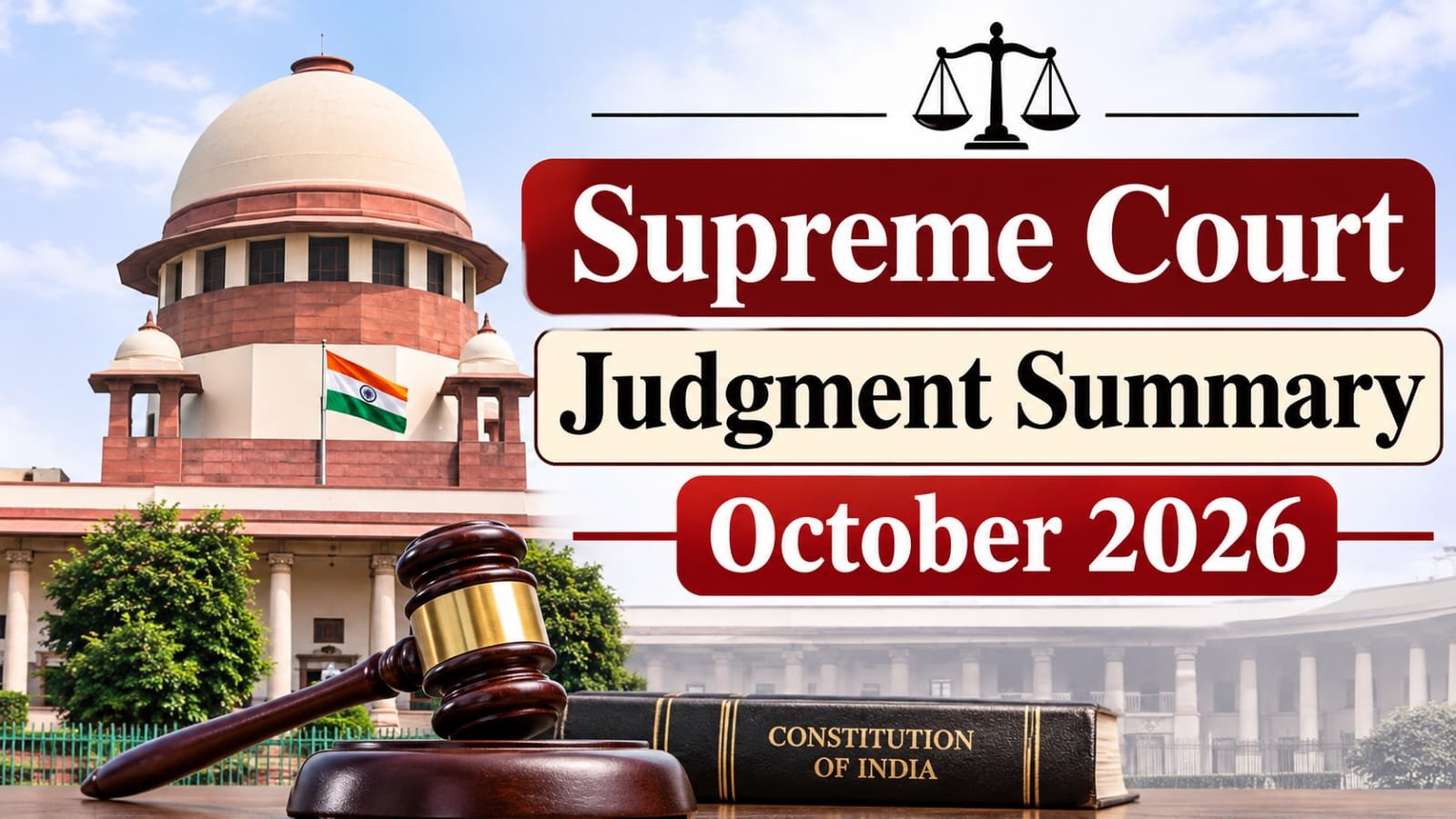
Supreme Court Judgments Summary
October 2026
Broken Chains of Circumstantial Evidence: Acquittal in a Child Sexual Assault and Murder Case
In this criminal appeal, the appellant challenged his conviction and sentence of life imprisonment under Sections 376(2)(i), 302, and 201 of the Indian Penal Code, 1860, as well as Sections 4 and 6 of the Protection of Children from Sexual Offences Act, 2012, which had been concurrently upheld by the Sessions Court and the High Court of Sikkim. The Supreme Court reviewed the circumstantial evidence presented by the prosecution—including the “last seen” theory, Section 27 recoveries, DNA reports, FSL results, and the appellant’s statement under Section 313 of the Code of Criminal Procedure, 1973. Finding that the chain of circumstances was broken and incomplete at multiple points, and that the DNA and forensic reports did not link the appellant or recovered remains to the victim, the Court gave the appellant the benefit of the doubt, set aside the lower court judgments, and ordered his immediate acquittal.
2026 INSC 1073: Santosh Gurung v. State of Sikkim (D.O.J. 01.10.2026)
Shadows of Circumstantial Doubt: Upholding Acquittal in a Double Murder Case
In this criminal appeal filed by the State of Himachal Pradesh, the Supreme Court examined whether the High Court was justified in setting aside the trial court’s judgment convicting and sentencing the respondent-accused under Section 302 of the Indian Penal Code, 1860, for the double murder of her stepmother and minor stepbrother. The prosecution relied heavily on circumstantial evidence, including the “last seen” theory, taxi travel logs, hotel stays, recovery of keys and a mobile phone via disclosure, and DNA profile matching of bloodstains found at the crime scene. Upon re-evaluating the record, the Supreme Court held that the prosecution failed to establish a complete and unbroken chain of circumstances pointing exclusively to the guilt of the accused. Finding serious investigational lapses—such as omitted mobile tower locations, untrustworthy corroborative witnesses, and non-conclusive forensic links—the Court upheld the High Court’s acquittal and dismissed the appeal.
2026 INSC 1074: State of Himachal Pradesh v. Anchla @ Chanchla (D.O.J. 01.10.2026)
Consensual Relationship Beyond Future Promises: Rape Case Stemming from Failed Marriage Proposal Quashed
The Supreme Court of India allowed a criminal appeal and quashed the charge-sheet and proceedings in Sessions Case No. 216 of 2025 pending against the appellant before the Additional Sessions Judge (FTC), Bilaspur, Chhattisgarh. The case was registered on allegations of rape/sexual exploitation under the false promise of marriage following the breakdown of a three-year consensual relationship. A Division Bench comprising Justice J.B. Pardiwala and Justice K. Vinod Chandran held that a long-standing, voluntary physical relationship between two educated adults cannot be given a criminal color under the guise of “misconception of fact” under Section 90 IPC simply because a future marriage proposal fell through. The Court emphasized that criminal prosecution cannot be reduced to a strong-arm tactic to force marriage.
2026 INSC 1081: Martanda Singh v. State of Chhattisgarh and Anr. (D.O.J. 01.10.2026)
Counter-Blast Allegations & Delayed Claims: Supreme Court Quashes “Rape on Promise of Marriage” FIR
The Supreme Court of India allowed a criminal appeal and quashed FIR No. 326 of 2025, Charge Sheet No. 5 of 2026, and all consequent proceedings in Criminal Case No. 147 of 2026 against the appellant and co-accused. A Division Bench comprising Justice J. B. Pardiwala and Justice K. Vinod Chandran evaluated the matter under the four-step framework for quashing criminal proceedings established in Pradeep Kumar Kesarwani v. State of U.P.. The Court found that the allegations of rape, delayed by over a year and a half, were brought as a counter-blast to prior extortion complaints filed by the appellant. It held that the criminal prosecution was initiated primarily to coerce the appellant into marriage, which constitutes a clear abuse of the judicial process.
2026 INSC 1082: Sachin Gupta v. The State of Chhattisgarh and Anr. (D.O.J. 01.10.2026)
Identification of Absconding Accused: Supreme Court Overrules Preemptory Quashing in NDPS Cases
The Supreme Court of India allowed an appeal filed by the State of Karnataka, setting aside a High Court order that had quashed criminal proceedings under Section 20(b)(ii)(C) of the NDPS Act against an absconding accused (Accused No. 3). A Division Bench of Justice J.B. Pardiwala and Justice K. Vinod Chandran held that precedents such as Tofan Singh, Pallulabid Ahmad Arimutta, Balwinder Singh, and Firdoskhan Khurshidkhan—which rule that confessional/disclosure statements lack evidentiary value for conviction or bail—do not justify the premature quashing of a pending prosecution against an absconder at the initial stage. The Court clarified that co-accused disclosures revealing the identity of a suspect who fled the spot serve as valid investigative leads, and restored the proceedings to the Special Court while granting the accused liberty to seek discharge at the appropriate stage.
2026 INSC 1083: The State of Karnataka & Anr. v. Sadiq Pasha (D.O.J. 01.10.2026)
Food Powders Cannot Be Taxed as Beverages Under Commercial Tax Act
The Supreme Court of India dismissed civil appeals filed by the Commercial Tax Department challenging a Madhya Pradesh High Court judgment that classified ‘GRD Powder’ and ‘GRD Mix’ under the residuary entry of Schedule II to the M.P. Commercial Tax Act, 1994. The Revenue sought to tax the products at a higher rate of 10% as ‘Non-Alcoholic Drinks and Beverages’ on the grounds that the product instructions and packaging direct consumers to dilute the powder in milk or water. A Division Bench comprising Justice Manmohan and Justice Arun Palli held that taxing statutes must be strictly construed and the incidence of taxation depends on the physical form of the product at the time of sale (the taxable event) rather than its intended end-use. Because the goods exist in powder or biscuit form at the point of sale, they cannot be forced into the beverage entry and are correctly exigible under the residuary entry at 8%.
2026 INSC 1078: Additional Commissioner Commercial Tax & Ors. v. Cadila Health Care Ltd. & Anr. (D.O.J. 05.10.2026)
Absence of Proof of Demand Fatal to Corruption Prosecution: Aacquittal Despite Recovery of Tainted Money
The Supreme Court of India allowed a criminal appeal, setting aside the judgments of the Jharkhand High Court and the Special Judge (ACB), Chaibasa, and cleared the appellant of charges under Sections 7 and 13(2) of the Prevention of Corruption Act, 1988. A Division Bench comprising Justice Ujjal Bhuyan and Justice Atul S. Chandurkar held that proof of demand and voluntary acceptance of illegal gratification is the sine qua non for establishing an offence under the PC Act. The Court reaffirmed that mere recovery of chemically-treated currency notes from an accused’s residence or a positive phenolphthalein test—devoid of direct or corroborative evidence showing actual demand and acceptance—is insufficient to sustain a conviction beyond reasonable doubt.
2026 INSC 1084: Ajit Kumar v. State of Jharkhand (D.O.J. 05.10.2026)
Judicial Consistency and Protection Against Criminalizing Civil Disputes: FIR Quashed Against Power of Attorney Holder
The Supreme Court of India allowed a criminal special leave petition, setting aside the High Court of Karnataka’s order and quashing the criminal proceedings against a General Power of Attorney (GPA) holder in FIR/Crime No. 121/2016. A Bench comprising Justice Satish Chandra Sharma and Justice Nongmeikapam Kotiswar Singh held that criminal process cannot be abused to settle purely civil contractual disputes. Reaffirming the principle of judicial consistency, the Supreme Court ruled that where criminal proceedings arising from a land sale transaction had already been quashed against the principal landowners by a Coordinate Bench, the GPA holder—who merely acted as a confirming party on their behalf—could not be subjected to criminal liability on artificially distinguished grounds.
2026 INSC 1086: Sudha Rakesh v. The State of Karnataka & Anr. (D.O.J. 05.10.2026)
Shielding In-Laws from Unsubstantiated Matrimonial Claims: Quashes Vague and General Penal Charges
The Supreme Court of India allowed a criminal appeal, setting aside the judgment of the Calcutta High Court and quashing the entire criminal proceedings under Sections 498A, 406, and 506 of the IPC, as well as Sections 3 and 4 of the Dowry Prohibition Act, 1961, against the elderly in-laws. A Bench comprising Justice Nongmeikapam Kotiswar Singh and Justice N. V. Anjaria held that courts must exercise extreme circumspection when criminal law is invoked in domestic disputes. Reaffirming the principles in State of Haryana v. Bhajan Lal, Arti Mehta v. State of M.P., and Geddam Jhansi v. State of Telangana, the Apex Court ruled that sweeping, omnibus, and uncorroborated allegations against the relatives of a husband—without specific overt acts or supporting material—cannot sustain a criminal trial and amount to an abuse of the judicial process.
2026 INSC 1087: Prasanta Kumar Dhar & Anr. v. The State of West Bengal & Anr. (D.O.J. 05.10.2026)
Supreme Court Enforces Accountability for Public Safety and Infrastructure Deficiencies
Taking suo moto cognizance of recent rape incidents in the Delhi NCR, the Supreme Court of India issued comprehensive interim directives to transition public safety from reactive crime investigation to proactive preventive policing. Drawing upon the “Broken Windows Theory,” the Court emphasized that unaddressed infrastructural lapses—such as non-functional CCTVs, poor street lighting, and unmonitored dark stretches—signal systemic neglect and invite criminal behavior. The Court ordered immediate real-time monitoring via war-room control centers, mandatory verification and display of identity for public transport operators, enhanced beat patrolling, streamlining of citizen grievance portals, and institutional accountability from top officials.
2026 INSC 1096: Suo Moto Writ Petition (Criminal) No. 6/2026: In Re: Recent Rape Incidents in Delhi NCR (D.O.J. 05.10.2026)
Protection Against Delay in Prosecution: Supreme Court Restores Discharge Order
In a criminal appeal challenging a High Court order that set aside a discharge granted 26 years prior, the Supreme Court of India allowed the appeal and restored the trial court’s order discharging the appellant. The Supreme Court held that subjecting an individual to trial after such an extraordinary lapse of time—where the High Court took a quarter of a century to decide a revision petition—violates the principles of justice. The Court also pointed out the logical absurdity in the High Court’s reasoning, which faulted the trial court for not following a precedent that was decided more than a decade after the discharge order was passed.
2026 INSC 1101: Rajnikant Dudhabhai Parmar v. The State of Gujarat & Ors. (D.O.J. 05.10.2026)
Upholding Candidate Eligibility and Rectifying Judicial Overreach
In this civil appeal, the Supreme Court examined the validity of a High Court judgment that had set aside a Central Administrative Tribunal (CAT) order directing the appointment of the appellant as a Librarian under the Law Department of Jammu and Kashmir. The appellant, who was the first waitlisted candidate, had acquired professional work experience while completing his integrated Master’s program. While the High Court held that the required three years of experience must be gained strictly after obtaining the post-graduate qualification, the Supreme Court set aside the High Court’s rulings, held that ambiguous or vague eligibility criteria in advertisements must be construed in favor of candidates who prima facie possess the qualifications, and restored the Tribunal’s direction to appoint the appellant, while modifying the grant of back-dated consequential service benefits.
2026 INSC 1104: Irfan Ahmad Hakak v. Union Territory of Jammu and Kashmir & Ors. (D.O.J. 05.10.2026)
Entitlement to Notional Increment and Pensionary Benefits for Long-Serving Permanent Daily-Wagers
This appeal before the Supreme Court of India arose out of a dispute regarding the entitlement to an annual increment accruing on the day immediately following an employee’s retirement (1st July), along with consequential pensionary arrears. The Single Judge of the Gujarat High Court granted the increment and arrears relying on established precedents. However, a Division Bench of the High Court reversed the decision after the State argued for the first time that the employees were daily-wagers and thus ineligible for increments applicable to regular employees. The Supreme Court set aside the Division Bench’s order, holding that daily-wagers who were conferred permanent status under the Government Resolution dated 17.10.1988 are entitled to annual increments and modified pensionary benefits.
2026 INSC 1088: Chhaganbhai Kohyabhai Pateliya and others v. The State of Gujarat and others (D.O.J. 06.10.2026)
Strict Adherence to Recruitment Rules: NIOS Open Schooling Cannot Be Equated to the “10+2 System of Education” Without Express Equivalence Provisions
This appeal concerned the selection process for the post of Vocational Instructor (Practical) in the trade of Plumber under the Directorate of Skills Development and Entrepreneurship, Government of Goa. The Supreme Court set aside the High Court of Bombay at Goa’s judgment, holding that a candidate possessing a Class 10th Secondary School Certificate from the National Institute of Open Schooling (NIOS) does not satisfy the specific statutory requirement of having passed “10th standard under 10+2 system of education”. The Court emphasized that courts cannot introduce concepts of equivalence or alter essential qualifications prescribed by an employer under Recruitment Rules, and higher marks in a written examination cannot cure the non-fulfillment of an essential eligibility criterion.
2026 INSC 1089: Santosh B. Naik v. State of Goa & Ors. (D.O.J. 06.10.2026)
Quashing Blacklisting Orders in Drug Tender Quality Failures
This appeal arose from a challenge to the Madhya Pradesh High Court’s orders which had declined to outrightly quash the blacklisting and debarment orders passed against the appellant-firm (a licensed drug manufacturer and supplier). The appellant’s products (Ascorbic Acid and Ethambutol Hydrochloride tablets supplied to government hospitals) were declared “Not of Standard Quality” (NSQ) based on initial laboratory reports, prompting authorities to blacklist the firm for three years and debar products for two years without following the mandatory second-sample re-testing procedure stipulated in the tender document.
2026 INSC 1143: M/s Jpee Drugs v. State of Madhya Pradesh and Others (D.O.J. 06.10.2026)
Classification of Electricity Subsidy: Revenue vs. Capital Receipt Under the Income Tax Act
The Supreme Court of India dismissed the civil appeal filed by M/s. Mepco Industries Ltd., affirming the findings of the lower tax authorities and the Madras High Court. The core legal issue was whether an electricity subsidy of ₹16,20,745 received by the appellant under a Government of Pondicherry scheme for Assessment Year 1997–98 constituted a tax-exempt capital receipt or a taxable revenue receipt. Applying the established “purpose test,” the Court held that because the subsidy was operational in nature—calculated based on power consumption after the commencement of production to lower electricity costs rather than for setting up capital assets—it must be treated as a revenue receipt liable to income tax.
2026 INSC 1090: M/s. Mepco Industries Ltd. v. Commissioner of Income Tax, Madurai (D.O.J. 07.10.2026)
Modification of Conviction: Differentiating Robbery from Grievous Hurt in the Absence of Stolen Asset Recovery
The Supreme Court of India partly allowed a criminal appeal preferred against the Bombay High Court’s judgment that had affirmed the appellant’s conviction under Section 394 of the Indian Penal Code (IPC) and a sentence of seven years rigorous imprisonment. The case pertained to a night-time farm assault in 1993, where the appellant was alleged to have assaulted the complainant and stolen her gold ornaments. While the Court held that the eyewitness identification of the appellant was reliable despite the lack of a Test Identification Parade, it observed that the charge of robbery under Section 394 IPC could not stand due to the non-recovery of stolen items or proof of stolen property. Applying the principle of cognate offences under Section 222 CrPC, the Apex Court altered the conviction to Section 325 IPC (causing grievous hurt) and reduced the sentence to the period of imprisonment already undergone (approximately 10 months).
2026 INSC 1091: The State of Maharashtra v. Appa (D.O.J. 07.10.2026)
Election Petitions: Strict Compliance Under Section 81 of the Representation of the People Act
The Supreme Court of India dismissed a Special Leave Petition challenging the Madras High Court’s dismissal of an election petition in limine. The petitioner had challenged the election of Respondent No. 1 to the Tamil Nadu Legislative Assembly from the Thirumayam Constituency. The primary legal question was whether the requirement of personal presentation of an election petition by the petitioner under Section 81 of the Representation of the People Act, 1951 (RP Act) and Rule 7 of the Madras High Court Election Petitions Rules, 1967 is mandatory, and whether non-compliance entails automatic dismissal at the threshold under Section 86(1) of the RP Act. The Apex Court affirmed that presentation “by” the petitioner himself is an essential statutory prerequisite and that failure to personally present the petition renders it non-maintainable, necessitating threshold dismissal under Section 86(1).
2026 INSC 1092: V. Pon. Paneerselvam v. S. Regupathy and Others (D.O.J. 07.10.2026)
Injury Location Does Not Negate Attempt to Murder
The Supreme Court of India allowed a criminal appeal filed against an order of the Rajasthan High Court, which had quashed the charge under Section 307 of the Indian Penal Code (IPC) against respondent No. 2 and directed the trial court to frame a charge under Section 308 IPC instead. Reversing the High Court’s ruling, the Apex Court held that to attract Section 307 IPC (attempt to murder), it is not essential that a fatal or life-threatening injury be inflicted, nor does the mere location of wounds on non-vital body parts exclude its applicability. Intention or knowledge must be deduced from the totality of circumstances—including the weapons used, persistent vehicular assault, prior animosity, and the manner of execution. Finding that a strong prima facie case existed and that courts should avoid mini-trials at the charge stage, the Supreme Court restored the trial court’s order framing charges under Section 307 IPC.
2026 INSC 1093: Abhishek v. State of Rajasthan & Ors. (D.O.J. 07.10.2026)
Statutory Qualification Rules Prevail: Reinstatement of Teacher Lacking NCTE-Recognized Certificate Quashed
The Supreme Court of India allowed a civil appeal filed by the State of Bihar and set aside the judgment of a Division Bench of the Patna High Court, which had ordered the reinstatement of a Trained Block Teacher with full back wages and monetary benefits. The Apex Court held that candidate eligibility for public employment must be judged as of the date of recruitment or application under the governing statutory rules. Because the respondent was appointed in 2007 under the Bihar Panchayat Elementary Teacher (Employment and Service Conditions) Rules, 2006, which strictly mandated a teacher training qualification from an institution recognized by the National Council for Teacher Education (NCTE), his 1995 pre-NCTE certificate from an unrecognized private college rendered him ineligible for the post at the time of appointment.
2026 INSC 1094: The State of Bihar and Ors. v. Nandeshwar Kumar (D.O.J. 07.10.2026)
Balance of Equity in Land Acquisition:SC Directs ₹15 Crore Additional Deposit While Continuing Interim Stay
The Supreme Court of India disposed of cross-appeals filed by M/s JK Paper Ltd. and private landowners against a common interim order of the Gujarat High Court in pending land acquisition First Appeals. While declining to interfere under Article 136 with disputed questions of fact regarding possession timelines and compensation calculations, the Apex Court directed the company to deposit an additional ₹15 crore with the High Court within two months to keep the stay on the enhanced award and execution proceedings operational. The Court rejected the company’s attempt to lower land value based on an existing gorge/waterlogging encumbrance, holding that such facts were known at the initiation of acquisition, and requested the High Court to expedite the final disposal of the pending appeals.
2026 INSC 1095: M/s JK Paper Ltd. v. Bipinchandra Natwarlal Shah & Ors. (D.O.J. 07.10.2026)
Sympathy Miscarries: Supreme Court Slams Indulgent Probation in Brutal Assault Case
In a sharp rebuke of judicial leniency, the Supreme Court set aside a High Court order that had released two brutal assault convicts under Section 4 of the Probation of Offenders Act, 1958. The case originated from a 2003 attack where the accused used a cutting weapon and a gun to inflict horrific, life-altering injuries on the victim over a business rivalry. Despite the severe nature of the crime and extensive criminal antecedents, the Trial Court gave a light sentence under Section 308 of the IPC, and the High Court subsequently granted probation based on the passage of time. The Supreme Court strongly condemned this approach, highlighting that the accused had spent not a single day in custody, while the victim continued to live with permanent disabilities and chronic pain. Consequently, the Apex Court allowed the appeal, cancelled the relief granted under the Probation of Offenders Act, ordered the accused to surrender within two weeks, and remanded the criminal appeals back to the High Court to be heard only after the accused are taken into custody.
2026 INSC 1114: Umesh Chand v. State of U.P. & Ors. (D.O.J. 07.10.2026)
SC Mandates Statutory Overhaul and High-Level Oversight Against Unethical Medical Inducements
In a Public Interest Litigation (PIL) under Article 32 of the Constitution of India, the Supreme Court addressed the lack of an enforceable legal framework to curb unethical marketing practices by pharmaceutical companies. The petitioners raised concerns regarding freebies, travel facilities, hospitality, and monetary inducements extended to doctors, which lead to irrational drug prescriptions, high healthcare costs, and public health risks like antimicrobial resistance. Recognizing that the right to health is an integral facet of the Right to Life under Article 21, the Court exercised its powers under Articles 32 and 142 to order the Union of India to constitute a high-level committee to examine the issue and lay down a binding statutory and regulatory mechanism for the pharmaceutical sector.
2026 INSC 1097: Federation of Medical & Sales Representatives Association of India & Ors. v. Union of India & Ors. (D.O.J. 08.10.2026)
Autonomy of Distinct Commercial Contracts
In an application filed under Section 11(6) of the Arbitration and Conciliation Act, 1996, the Supreme Court of India held that independent commercial agreements—specifically a Joint Venture Agreement (JVA) and a Memorandum of Understanding (MoU)—cannot be overridden by a foreign jurisdiction clause contained in a prior “mother” License Agreement when the agreements cover distinct subject matters and contain explicit supersession clauses. Maintaining the principle of minimal judicial intervention under Section 11(6-A), the Court appointed a Sole Arbitrator to adjudicate the disputes arising in India under the JVA and MoU, relegating contentious issues regarding non-signatory subsidiary entities and jurisdictional overlap to the tribunal.
2026 INSC 1098: Shubham Equipment Private Limited & Anr. v. Rothwell Water Company Limited & Ors. (D.O.J. 08.10.2026)
Reaffirmation of Evidentiary Burden in Public Servant Misappropriation: Reversal of Acquittal Set Aside
In a criminal appeal challenging the reversal of an acquittal, the Supreme Court of India set aside the judgment of the Bombay High Court (Aurangabad Bench) and restored the trial court’s order acquitting a public servant accused of criminal breach of trust under Section 409 of the Indian Penal Code, 1860. The Supreme Court held that the prosecution failed to prove the basic ingredients of entrustment and dishonest intention beyond reasonable doubt. Furthermore, the Court observed that the High Court erred in reversing a well-reasoned acquittal by shifting the burden of proof onto the accused, relying on an unproven seizure, ignoring adverse inferences against the prosecution for withholding primary records, and failing to hear the appellant on the quantum of sentence before convicting him for the first time.
2026 INSC 1099: Ramkrushna Prahllad Dongardive v. The State of Maharashtra (D.O.J. 08.10.2026)
Arbitration: SC Shields Creditors from One-Sided Recovery by Successful Resolution Applicants
In a civil appeal arising out of an order under Section 11(6) of the Arbitration and Conciliation Act, 1996, the Supreme Court of India addressed whether a Successful Resolution Applicant (SRA)—who re-entered management of a Corporate Debtor (CD) post-CIRP—can pursue pre-CIRP arbitral claims against an Operational Creditor (OC) without allowing the OC to claim a set-off for its extinguished dues. The Court held that while the “clean slate” principle under Section 31(1) of the Insolvency and Bankruptcy Code, 2016 (IBC) extinguishes claims against the CD, enforcing a one-sided arbitration against the OC creates gross inequity. Exercising its equitable powers, the Supreme Court modified the High Court’s order to permit the Operational Creditor to raise its pre-CIRP claims as a counterclaim strictly for the purpose of a set-off, protecting them from positive recovery liabilities without granting affirmative monetary relief.
2026 INSC 1103: Modern Asset v. KNK Construction Private Limited (D.O.J. 08.10.2026)
Balancing Land Acquisition Liabilities: Deposit, Partial Release, and Expedited High Court Appeals
In this batch of special leave petitions arising from land acquisition proceedings under the Shatabdi Nagar Housing Scheme dating back to 1987, the Supreme Court addressed interim compensation orders passed while First Appeals were pending before the High Court of Judicature at Allahabad. The Reference Court had substantially enhanced compensation from the original awards of Rs. 20/- and Rs. 27/- per square yard to Rs. 690/- and Rs. 720/- per square yard. To maintain parity with similar housing scheme matters, the Supreme Court disposed of the petitions by directing the Meerut Development Authority to deposit the entire enhanced compensation awarded by the Reference Court with the High Court registry within four weeks. Out of this amount, 8.33% is to be released to the landowners, while the balance must be invested in interest-bearing fixed deposits on an auto-renewal basis pending the outcome of the first appeals. Furthermore, the Court requested the High Court to expedite the pending appeals and render a decision within six months.
2026 INSC 1106: Meerut Development Authority v. Parmeshwar Dayal & Anr. (with connected Special Leave Petitions) (D.O.J. 08.10.2026)
Unraveling Reasonable Doubt: A Critical Examination of Identity, Delay & Evidence in POCSO
In this criminal appeal, the Supreme Court addressed the conviction of the appellant under Section 6 of the Protection of Children from Sexual Offences (POCSO) Act, 2012, for the alleged sexual assault of his specially-abled minor niece. The trial court had convicted and sentenced the appellant to 10 years of rigorous imprisonment, which was subsequently affirmed by the High Court of Meghalaya. Upon a rigorous re-appreciation of the evidence, the Supreme Court set aside the judgments of both lower courts, holding that the prosecution failed to establish the guilt of the accused beyond a reasonable doubt due to a 10-day unexplained delay in lodging the FIR, material contradictions in witness testimonies, the failure of key witnesses to identify the accused in court, the withholding of a material witness (the school teacher), and a plausible defense of alibi. Consequently, the appellant was granted the benefit of the doubt and ordered to be released forthwith.
2026 INSC 1102: Charming Rupon v. State of Meghalaya (D.O.J. 09.10.2026)
Seniority Wars: Resolving Cadre Hierarchies Between Direct Recruits, Special Appointees, and Compassionate Appointees
This batch of civil appeals and transferred cases addressed a complex, long-standing inter se seniority dispute in the Tamil Nadu Ministerial and Judicial Ministerial Services involving three distinct categories of employees: Direct recruits (1983 batch selected via the TNPSC competitive examination), Special appointees (temporary employees appointed under Rule 10(a)(i) and later regularized under the Special Absorption Rules, 1987), and Compassionate appointees. The Supreme Court modified the Madras High Court’s common judgment dated April 3, 2006, holding that while Direct recruits must rank above both Special appointees and Compassionate appointees, Compassionate appointees cannot leapfrog over regular Direct recruits based solely on their initial date of temporary/stopgap appointment. The Court reaffirmed core service jurisprudence principles that regular public service recruitment trumps back-door, stopgap, or compassionate appointments in matters of cadre seniority.
2026 INSC 1105: M. Prema v. The State of Tamil Nadu & Ors. (with connected Civil Appeals and Transferred Cases) (D.O.J. 09.10.2026)
From Limited Estate to Absolute Ownership: Interpreting Section 51(2) of the Delhi Land Reforms Act & Hindu Succession Act
In this civil appeal, the Supreme Court interpreted the scope and operation of Section 51(2) of the Delhi Land Reforms Act, 1954 (Act, 1954) in conjunction with Section 14(1) of the Hindu Succession Act, 1956 (HSA, 1956). The dispute revolved around the devolution of agricultural land left behind by Smt. Khajano, who had initially inherited a limited life estate from her first husband/son before the 1954 Act and later remarried. Following her demise in 1973, a mutation dispute arose between her sons from her second marriage (Respondents No. 2 and 3) and the collateral reversioners (Appellants). Upholding the Delhi High Court Division Bench’s ruling, the Supreme Court held that the expression “personal law applicable to her” in Section 51(2)(a)(ii) of the Act, 1954 is a general referential incorporation. Consequently, by operation of Section 14(1) of the HSA, 1956, her limited estate blossomed into an absolute property right, shifting the course of succession from Section 50 to Section 53 of the Act, 1954, and making her sons the rightful successors.
2026 INSC 1107: Sultan Singh (Dead) through LRs and Others v. The Financial Commissioner, Government of NCT of Delhi and Others (D.O.J. 09.10.2026)
Supreme Court Clarifies Jurisdiction When Arbitration Clauses Point to Multiple Locations
This civil appeal challenged an order passed by the Delhi High Court under Section 11(6) of the Arbitration and Conciliation Act, 1996, which had appointed an sole arbitrator and left the venue choice to them. The Supreme Court allowed the appeal, setting aside the Delhi High Court’s order on the ground that the High Court lacked territorial jurisdiction. The Apex Court held that when an arbitration clause designates multiple locations (such as both Delhi and Goa), the designation alone cannot automatically determine the juridical seat. By reading the agreement as a whole alongside the governing law and jurisdiction clause (which exclusively vested jurisdiction in the courts of Goa), the Court concluded that Goa was the true juridical seat of arbitration while Delhi was merely a venue, meaning only the jurisdictional High Court of Goa could entertain applications under Section 11.
2026 INSC 1109: Arcis Clean Energy Pvt. Ltd. v. Parshva Innovation (D.O.J. 12.10.2026)
When E-Payments Meet Paper Rules: SC Quashes Tender Rejection Over “Original” Bid Security Demands
This civil appeal challenged a Division Bench judgment of the Patna High Court which had affirmed the rejection of the appellant’s technical bid for an Engineering, Procurement, and Construction (EPC) rail link project. The respondent authorities rejected the bid because the appellant failed to submit the “original” of the bid security, as stipulated under Clause 2.20.6(ii) of the Request for Proposal (RFP), despite the appellant having remitted the security via the official e-payment gateway and uploading its digital receipt. The Supreme Court allowed the appeal and set aside the High Court’s order, holding that demanding the physical production of an original receipt for an e-payment—where funds have already directly entered the government’s account—is a legal perversity and an impossibility. The Court ruled that rigid adherence to paper-form rules cannot be used to invalidate an e-payment bid security, and consequently directed that the appellant’s bid be processed.
2026 INSC 1110: Hardev Construction Private Limited v. Union of India & Ors. (D.O.J. 12.10.2026)
Unravelling Non-Signatory Liability: SC Rules on Veritable Parties and the Reach of Arbitration Agreements
This civil appeal challenged a portion of a High Court order under Section 11 of the Arbitration and Conciliation Act, 1996, which had declined to include the 3rd and 4th respondents in ongoing arbitration proceedings on the ground that they were non-signatories to the original arbitration agreement. The Supreme Court allowed the appeal in part, modifying the High Court’s order to hold that the 3rd and 4th respondents are veritable parties to the dispute on a prima facie view. The Court reasoned that the ownership of the subject commercial asset hinges entirely on whether a disputed 1995 retirement deed is valid, which directly impacts the subsequent partnership deeds under which the 3rd and 4th respondents claim rights. Consequently, non-signatories intimately linked to the subject matter and core commercial obligations cannot be shut out at the threshold, leaving all questions of limitation and estoppel open for the Arbitral Tribunal to decide.
2026 INSC 1111: Hemant D. Shah HUF & Anr. v. Chittaranjan D. Shah HUF & Ors. (D.O.J. 12.10.2026)
Plaint Amendments: SC Rules on Late-Stage Amendments and the Discovery of Unknown Decrees
This civil appeal challenged an order of the Orissa High Court which declined to interfere with a trial court order rejecting an application under Order VI Rule 17 of the CPC for amending a plaint in a long-standing title suit. The original plaintiff had sought to incorporate foundational pleadings regarding a compromise decree in a separate suit (T.S. No. 105 of 1998) which he discovered later and which purportedly affected a portion of the suit property. The Supreme Court allowed the appeal and set aside the orders of the High Court and trial Court, holding that the statutory requirement of “due diligence” under the proviso to Order VI Rule 17 was satisfied because the plaintiff was not a party to the prior compromise suit and only discovered it upon obtaining certified copies. The Court emphasized that a liberal approach should be adopted to prevent multiplicity of proceedings, leaving all questions regarding limitation, maintainability, and the applicability of Order XXIII Rule 3A open for the trial court to determine.
2026 INSC 1112: Haramani Sahoo and Others v. Lalita Nayak and Others (D.O.J. 12.10.2026)
Supreme Court Clarifies That Disability Pension Precedent Cannot Be Mechanically Applied
This miscellaneous application was filed by the Union of India seeking a clarification of the Supreme Court’s common judgment dated February 12, 2026 (passed in C.A. Nos. 6820-6824 of 2018), which had granted ex-servicemen disability pension with broad-banding benefits and arrears from specified dates. The Union of India contended that the judgment was being mechanically relied upon by various courts and tribunals to alter final orders and reopen stale pensionary claims where the very entitlement to a disability pension was initially in dispute. The Supreme Court disposed of the application by clarifying that judgments must be read in the context of their specific facts and that the common judgment cannot be construed to mean that disability pension with arrears can be automatically claimed in every case. The Court emphasized that each claim must be examined and decided on its own individual merits.
2026 INSC 1113: Union of India Through Its Secretary & Ors. v. SGT Girish Kumar and Ors. (D.O.J. 12.10.2026)
A Minor Discrepancy in a Death Certificate Does Not Constitute Forgery or Cheating
The Supreme Court allowed the criminal appeal and quashed the criminal proceedings and charge-sheet pending against the appellant in Muzaffarnagar. The case arose from an FIR alleging that the appellant had deliberately provided false information and forged her mother’s death certificate by stating the date of death as November 21, 2019, instead of November 20, 2019. The Supreme Court held that since the certificate was officially issued by the Competent Authority under the Panchayati Raj Department, no forgery or criminal breach of trust was involved on the part of the applicant. Furthermore, a simple discrepancy in dates—submitted via a Jan Sewa Kendra due to a lack of technical savviness and without any intent to claim wrongful benefits—cannot attract offences under Section 420 or Section 465 of the IPC, rendering the continuation of the prosecution an abuse of process.
2026 INSC 1119: Pooja v. State of U.P. & Anr. (D.O.J. 12.10.2026)
Service Law: Absorption: Supreme Court Sets Aside High Court Mandate While Granting Ex-Gratia Relief
In this case, the Supreme Court addressed the legal validity of a High Court order directing the State to absorb a terminated lecturer from a “no grant-in-aid” educational institution and award substantial compensation. The respondent-lecturer had been terminated in 1999 following a departmental inquiry, a decision initially upheld by the University and College Tribunal but later reversed by the Bombay High Court. The Supreme Court allowed the State’s appeal, holding that the High Court committed a fundamental procedural error by issuing a mandamus fastening financial and administrative liability upon the State without the State of Maharashtra ever being formally impleaded as a party respondent. On merits, the Court reiterated that teachers from unaided institutions are excluded from the State’s surplus absorption policies, and Article 14 cannot be invoked to claim negative equality based on inadvertent benefits granted to others. However, recognizing that the lecturer had fought litigation for decades and retired during the pendency of the appeal, the Supreme Court invoked its extraordinary powers under Article 142 of the Constitution to award a consolidated ex-gratia compensation of ten lakh rupees in full and final settlement.
2026 INSC 1118: State of Maharashtra v. Sudhir S/o Motiramji Hiwarkar & Ors. (D.O.J. 13.10.2026)
Bridging the Gap Between “May Be” and “Must Be”: Acquittal in Circumstantial Murder Trials Lacking Conclusive Forensic Links
This appeal arose from a judgment of the Chhattisgarh High Court which affirmed the trial court’s conviction and sentencing of the appellant under Sections 302 and 201 of the Indian Penal Code (IPC) for the alleged murder of Saurabh Panda. The deceased was found dead in an open field next to his motorcycle with a yellow rope, initially reported as an accidental death. The prosecution’s case rested entirely on circumstantial evidence: a WhatsApp message exchanged between two witnesses (PW-5 and PW-6) suggesting a quarrel at the appellant’s house, alleged disclosure statements leading to the recovery of weapons (an iron rod and a screwdriver), blood-stained soil, and unverified bodily injuries on the appellant.
2026 INSC 1148: Kusumlal Sao v. State of Chhattisgarh (D.O.J. 13.10.2026)
Education: Supreme Court Restricts Midstream Fee Hikes for Professional Courses
The Supreme Court partially allowed the appeals filed by self-financing engineering and professional colleges while upholding the final relief granted by the Calcutta High Court’s Division Bench. The core legal question revolved around whether professional education fees in self-financing Higher Education Institutions (HEIs) could be altered midstream. The Supreme Court ruled that fee structures must provide financial certainty to students and parents at the threshold of a course, and fees determined at the commencement cannot be varied mid-course unless exceptional and unforeseen circumstances arise. The Court criticized the State Government and the fee fixation committees for administrative inefficiency in delaying the revision exercise for seven years (last revised in 2016-17, updated via notification on October 16, 2023). Consequently, while clarifying that the notification could not apply retrospectively to students whose admissions were already finalized before October 16, 2023, the Court affirmed the High Court’s directions requiring colleges to refund or adjust any excess fees collected from those students.
2026 INSC 1120: Dr. B.C. Roy Engineering College & Anr. v. The State of West Bengal & Ors. (D.O.J. 14.10.2026)
Supreme Court Dismisses IBC Appeal as Barred by Limitation
The Supreme Court sustained a preliminary objection raised by Respondent No. 2 and dismissed the civil appeal filed by the Central Tax Department under Section 62 of the Insolvency and Bankruptcy Code, 2016 (IBC) as time-barred. The appeal challenged an NCLAT order dated August 2, 2023, which had confirmed an NCLT-approved resolution plan. The apex court held that the IBC is a self-contained, special code that mandates strict timelines to preserve asset value and economic health, and its limitation periods cannot be defeated by indefinite or fluctuating interpretations of when a copy of an order is received. By computing the 35 days of pre-application inaction (which cannot be excluded under Section 12 of the Limitation Act) and factoring in the absolute 60-day statutory ceiling under Section 62 of the IBC (45 days plus a maximum 15-day condonable grace period), the Court ruled that the appeal—filed on November 21, 2023—exceeded its jurisdiction to condone delay.
2026 INSC 1121: The Assistant Commissioner of Central Tax, CGST Division v. Srinivasa Rao Ravinuthala and Another (D.O.J. 14.10.2026)
Third-Party Obstruction in Execution Proceedings: Supreme Court Sets Aside Dismissal and Remands Back
The Supreme Court allowed the civil appeal, setting aside the concurrent orders of the Executing Court and the High Court which had dismissed the appellant’s claim petition regarding a property execution decree. The dispute centered around execution proceedings filed by Respondent No. 1 for physical possession of property following an ex parte specific performance decree. The appellant, a third-party wakf claiming independent title and possession through historical grants and gazette notifications, resisted execution. Both lower courts dismissed the objection partly on technical grounds—holding that an application under Order XXI Rule 58 of the CPC was not maintainable against a warrant for possession (as opposed to attachment)—and faulted the appellant for failing to discharge the burden of proof. Relying on its recent precedent in Periyammal, the Supreme Court held that citing a wrong provision of law cannot defeat a third party’s substantive rights, and that obstruction or resistance by a stranger to a decree must be fully inquired into under Order XXI Rules 97 to 101 of the CPC. Consequently, the Court set aside the impugned judgments and remanded the matter back to the Executing Court for a fresh, comprehensive inquiry after permitting both parties to file additional pleas and evidence.
2026 INSC 1122: Alladin Charities and Zakat Wakf v. Mohammed Saleem Alias Mohd. Wajid Ali and Another (D.O.J. 14.10.2026)
Bail Granted in Multi-Crore PMLA Case: Prolonged Incarceration Overrides Twin Conditions
The Supreme Court allowed the criminal appeal filed by the appellant and set aside the Calcutta High Court’s order, thereby granting regular bail to the accused under the Prevention of Money Laundering Act, 2002 (PMLA). The appellant, accused of orchestrating a complex web of financial transactions and shell companies involving proceeds of crime amounting to over ₹6,210.72 crores, had already undergone approximately 20 months of incarceration. While the Court rejected the appellant’s contention that a 5-day delay in forwarding the arrest order to the Adjudicating Authority vitiated the arrest under Section 19(2), it nonetheless held that the stringent twin conditions under Section 45 of the PMLA cannot override the fundamental constitutional safeguards of Article 21. Emphasizing that the massive volume of evidence (97 accused, 48 witnesses, and 15,000 pages of documents) rendered a speedy trial impossible, the Court granted bail to prevent indefinite detention from becoming a pre-trial punishment.
2026 INSC 1124: Sanjay Sureka @ Sanjay Kumar Sureka v. Directorate of Enforcement (D.O.J. 14.10.2026)
Arbitrary Cancellation of Sand Mining Tenders: SC Sets Aside Rejection of Highest Bids
The Supreme Court allowed the civil appeals filed by M/s Dhanlaxmi Merchandise Pvt. Ltd. and Sahakar Global Limited, setting aside the Madhya Pradesh High Court’s judgment and the State Mining Corporation’s decision to cancel the e-tender-cum-auction for the Katni and Shahdol sand groups. The Corporation had rejected the highest bids and cancelled the tenders primarily because the appellants—who had previously operated the same groups before lawfully surrendering their contracts under the rules then in force—returned to the fresh auction with bids that were substantially lower than their historical offers. The Supreme Court held that while an H1 bidder has no indefeasible right to an allotment, the rejection of an above-reserve highest bid must be supported by relevant material demonstrating current market inadequacy rather than merely pointing out a numerical drop from a past contract. The Court ruled that under the regulatory regime prevailing in September 2025, surrendering MDOs were not disqualified from participating, and a past bid cannot serve as an immutable minimum benchmark without proving that the fresh competitive auction failed to fetch the true current market value. Consequently, the Court restored the September 2025 tender process in favor of the appellants, subject to their reaffirming their final bids and completing necessary formalities.
2026 INSC 1125: M/s Dhanlaxmi Merchandise Pvt. Ltd. v. State of Madhya Pradesh & Ors. (D.O.J. 14.10.2026)
Family Property Dispute : SC Upholds Validity of Compromise Decree and Nullifies Unauthorized Gift Deed
The Supreme Court allowed the civil appeal, setting aside the concurrent judgments of the Telangana High Court and the trial court, and decreed the appellants’ suit for a declaration of title and to declare a gift deed null and void. The litigation originated from a 1959 family settlement and subsequent partition suits, during which a formal compromise (“Settlement of Dispute” dated February 24, 1986) was recorded in a high court appeal under Order XXIII Rule 3 of the CPC. Under this compromise—which received judicial imprimatur on September 7, 1990—Madhusudhan Reddy relinquished all claims over properties allotted to his mother (Manikyamma) in favor of Anasuyamma and her adopted son. Despite this binding settlement, Madhusudhan Reddy executed a gift deed in 2007 conveying lands that did not belong to his share and which he had expressly surrendered. Both lower courts erred by ignoring the binding effect of the compromise decree. The Supreme Court rectified these fundamental errors and decreed the suit, noting that the respondents chose not to contest the appeal despite service and an interim status quo order.
2026 INSC 1126: B. Anasuyamma (Died) Per LR and Another v. B. Madhusudhan Reddy (Died) Per LRs and Others (D.O.J. 14.10.2026)
SC Directs University to Verify Credentials and Release Government Employee’s Salary
The Supreme Court allowed the civil appeal filed by the appellant, setting aside the Himachal Pradesh High Court’s order which had relegated the appellant to approach a civil court. The appellant, a B.Tech graduate from Manav Bharti University, had been appointed as a Sub-Inspector in the State Taxes Department, Jammu and Kashmir, but his appointment could not be confirmed and he remained unpaid because the University failed to verify his credentials due to records seizure and administrative omissions. The Supreme Court held that the omission of the appellant’s name from the admission disclosure list was an inadvertent clerical error by the University’s previous administration, for which an innocent student cannot be penalized. Emphasizing that the appellant was a bona fide student who passed all examinations and that minor mark discrepancies in the 7th and 8th semesters still reflected a ‘pass’, the Court directed the State and the University to complete the verification, issue corrected mark sheets, and ensure the release of all salary arrears and consequential benefits to the appellant within specified timelines.
2026 INSC 1127: Mohd. Asad Choudhary v. State of Himachal Pradesh and Others (D.O.J. 14.10.2026)
Appealability of Contempt Orders and Intra-Court Appeal Scope
The Supreme Court disposed of a civil appeal filed by an alleged contemnor against an interim order of a Single Judge of the Allahabad High Court (Lucknow Bench) passed in a contempt application, which had rejected a compliance affidavit and threatened personal appearance and framing of charges. The apex court held that an intra-court appeal (Special Appeal) is maintainable against an order passed by a Single Judge in contempt proceedings where the court oversteps its jurisdiction by adjudicating on the merits of the underlying dispute or determining substantive rights, rather than merely imposing a punishment for contempt. Expressing respectful disagreement with the 3-Judge Bench decision in Ram Kishan Fauji v. State of Haryana—which held that writ proceedings originating from criminal law constitute the exercise of “criminal jurisdiction” and bar intra-court appeals—the Court formulated specific questions and referred the matter to the Chief Justice of India for constitution of a larger bench to reconsider Ram Kishan Fauji. Consequently, the appeal was disposed of with liberty to the appellant to file a Special Appeal before the High Court, staying the contempt proceedings for two months.
2026 INSC 1128: Sanjay Prasad v. Madhusudan Dwivedi & Ors. (D.O.J. 14.10.2026)
Can Conversion Bridge Backward Class Reservation
This appeal addressed whether an individual belonging to a Backward Class, Most Backward Class, Denotified Community, or Scheduled Caste prior to converting from Hinduism to Islam can automatically claim the status and reservation benefits of a Backward Class Muslim. The Supreme Court upheld the Madras High Court’s decision, which declared unconstitutional the Government of Tamil Nadu’s G.O.(Ms.) No. 31 dated March 9, 2024, enabling such seamless transfers of backward status upon religious conversion. The Court ruled that conversion to Islam establishes religious affiliation but does not automatically confer membership into a historically or socially distinct notified Muslim backward community. Consequently, the State cannot use executive fiat to bridge pre-conversion social disadvantages into post-conversion community-based reservations without an independent, legally valid foundation.
2026 INSC 1129: Secretary to Government v. Sameer Ahamed N. and Others (D.O.J. 15.10.2026)
Supreme Court Decides Refund Mechanics in Delayed Construction Projects
These three cross-appeals arose from orders of the National Consumer Disputes Redressal Commission (NCDRC) regarding a consumer complaint filed by a homebuyer (Borrower) who sought a refund for a delayed residential apartment project (“Lodha Bellezza” in Hyderabad) funded partly by his own savings and partly through a tripartite housing loan from Housing Development Finance Corporation Limited (HDFC Bank). The Supreme Court modified the NCDRC’s order to prevent unjust enrichment, holding that the Borrower is only entitled in his own right to a refund of the exact amount he paid out of his pocket (along with contractual interest at 12% per annum and ₹15 Lakhs as composite compensation), while the remaining loan-disbursed funds deposited by the builder must be preserved pending the outcome of the Bank’s recovery appeal before the High Court.
2026 INSC 1131: Madhu Kudapa (formerly known as K. Madhusudhan Rao) v. M/s Lodha Healthy Constructions and Developer Private Limited (LHCPL) & Anr. (D.O.J. 15.10.2026)
Supreme Court’s Verdict on Yes Bank’s AT-1 Bonds Write-Down
This batch of civil appeals—filed by Yes Bank, the Reserve Bank of India (RBI), and the Union of India—challenged the Bombay High Court’s judgment dated January 20, 2023, which had set aside the Administrator’s March 14, 2020 decision to permanently write down Basel III compliant Additional Tier 1 (AT-1) Bonds worth over ₹8,400 crores. The Supreme Court dismissed the appeals, holding that the Administrator’s action was ultra vires the Master Circular, the Information Memoranda, and the final Yes Bank Limited Reconstruction Scheme, 2020. The Court ruled that once the Central Government consciously deleted the write-down clause from the final Reconstruction Scheme during the deliberative process, the Administrator lacked the authority to unilaterally dismantle that decision and write down the bonds. Furthermore, the power to activate the Point of Non-Viability (PONV) write-down vested solely with the RBI under the statutory framework, which the Administrator could not independently assume.
2026 INSC 1132: Yes Bank Limited & Anr. v. Axis Trustee Services Limited & Ors. (D.O.J. 15.10.2026)
Weaponizing Atrocity Laws: Criminal Prosecution Against Bank Officials Quashed
This criminal appeal arose from a High Court order refusing to quash criminal proceedings and an FIR initiated under the Scheduled Caste and Scheduled Tribes (Prevention of Atrocities) Act, 1989 against bank officials. The Supreme Court allowed the appeal and quashed the criminal proceedings, holding that a beleaguered business enterprise whose loan accounts turned into Non-Performing Assets (NPAs) cannot retaliate by filing false and frivolous atrocity complaints against bank officers over commercial disputes, non-compliance with RBI circulars, or the denial of rehabilitation packages. The Court ruled that civil or commercial grievances regarding loan recoveries and regulatory guidelines must be agitated before appropriate forums like the Debts Recovery Tribunal rather than being weaponized into criminal prosecutions under the SC&ST Act in the absence of specific caste-based denigration.
2026 INSC 1133: Chavan Dharmendar & Ors. v. The State of Telangana & Ors. (D.O.J. 12.10.2026)
The Hierarchy of Proof in Insolvency: SC Decodes Information Utilities and Default Thresholds under the IBC
These statutory appeals under Section 62 of the Insolvency and Bankruptcy Code, 2016 (IBC) challenged a common judgment of the National Company Law Appellate Tribunal (NCLAT) which affirmed the admission of Section 7 applications initiated by Omkara Asset Reconstruction Pvt. Ltd. against GSTAAD Hotels Pvt. Ltd. and Neo Capricorn Plaza Pvt. Ltd. (owners of the JW Marriott Hotel, Bangalore and Crowne Plaza Hotel, Pune respectively). The Supreme Court dismissed the appeals and upheld the initiation of the Corporate Insolvency Resolution Process (CIRP), holding that Section 7 proceedings require a summary ascertainment of a static historical default rather than a forensic accounting reconciliation. The Court formulated a clear evidentiary hierarchy—placing authenticated records of Information Utilities at the apex—and emphasized that profitability or positive EBITDA does not negate a corporate debtor’s legal liability when debt service obligations are unmet.
2026 INSC 1134: Deepak Raheja and Another v. Omkara Assets Reconstruction Private Ltd. and Another (D.O.J. 15.10.2026)
Contractual Bars on Pre-Reference and Pendente Lite Interest under the Arbitration Act
This civil appeal arose from a final judgment of the Division Bench of the High Court of Delhi which had dismissed an appeal under Section 37 of the Arbitration and Conciliation Act, 1996, thereby upholding a Single Judge’s order setting aside an arbitral award of pre-reference and pendente lite interest. The Supreme Court dismissed the appeal, holding that Clause 26 of the Special Conditions of Contract (SCC), which concluded with the comprehensive residuary phrase “or otherwise,” operated as an absolute contractual bar under Section 31(7)(a) of the 1996 Act preventing the Arbitral Tribunal from awarding pre-reference and pendente lite interest. The Court ruled that such a clause is analogous to clauses explicitly prohibiting interest “in any other respect whatsoever,” and since party autonomy reigns supreme under Section 31(7)(a), an arbitrator cannot act contrary to explicit contractual exclusions.
2026 INSC 1135: M/s Sharma Enterprises v. National Building Construction Corporation (D.O.J. 15.10.2026)
Enhancing Compensation for Severe Motor Accident Disabilities
These civil appeals arose from a common judgment of the Kerala High Court modifying a Motor Accident Claims Tribunal award concerning a severe accident on October 22, 2016, involving two scooter riders. The first appellant (Sunil Kumar, a pillion rider) suffered debilitating head injuries resulting in total dependency, while the second appellant (Sreejith K.S., the driver) suffered multiple fractures and nerve injuries affecting his arm. Dissatisfied with the extent of enhancement granted by the High Court, both claimants approached the Supreme Court.
2026 INSC 1145: Sunil Kumar (Totally Disable Rep. by Wife) v. IFFCO Tokio General Insurance Company Ltd. (D.O.J. 15.10.2026)
The Limits of Letters Patent Appeal Against Writ Court Orders
This appeal addressed the vital question of law regarding the scope, powers, and jurisdiction of a Division Bench under Clause 15 of the Letters Patent to interfere with an order passed by a Single Judge exercising writ jurisdiction under Article 226 of the Constitution. The appellant, a Deputy Registrar at Periyar University, was removed from service following a One-man Commission inquiry that found him guilty of misconduct (including influencing university affiliation for his wife’s college and holding assets disproportionate to his income).
2026 INSC 1136: R. Saravanan v. Periyar University Rep. by its Registrar & Ors. (D.O.J. 16.10.2026)
The Limits of Part-Performance and Limitation in Property Law
This appeal arose from a long-standing property dispute relating to Plot No. 8, Friends Colony, New Delhi, initially allotted to late Shri Sohan Singh under a 1952 Agreement to Sell. Because Sohan Singh failed to raise construction within the stipulated three-year timeframe and explicitly requested the housing society via a 1954 letter to transfer the plot to his nephew (Defendant No. 1), the society executed a registered sale deed in favor of Defendant No. 1 in 1960. Decades later, the legal heirs of Sohan Singh (the Plaintiffs) filed a suit for possession without seeking a declaration or cancellation of the sale deed. Both the trial court and the Delhi High Court dismissed the suit.
2026 INSC 1137: Smt. Rano Singh and Others v. Sh. Gurbax Singh (D) thr. LRs. and Others (D.O.J. 16.10.2026)
Private Complaints for False Election Affidavits: Overruling the Bar of Section 195 CrPC
This appeal addressed an important, undecided question of law: whether Section 125-A of the Representation of the People Act, 1951 (RoP Act)—which penalizes filing false information or concealing facts in an election nomination affidavit—must pass muster the rigours of Section 195(1) of the Code of Criminal Procedure, 1973 (CrPC), thereby restricting complaints solely to public servants or the Election Commission.
2026 INSC 1138: Sri. Rajkumar Madki v. Dr. Shailendra Beldale (D.O.J. 16.10.2026)
Judicial Duty to Reason: Setting Aside Bail Orders Passed Without Examining Critical Video Evidence
These appeals were filed by the father of the deceased (Chandan Ram) challenging the Patna High Court’s orders granting anticipatory bail to one accused and regular bail to two other accused persons in a high-profile murder and attempt-to-murder case arising from violence during the Lok Sabha elections. The Supreme Court allowed the appeals, set aside the impugned bail orders, and remanded the matters back to the High Court for fresh consideration. The Court held that the High Court completely failed to consider crucial material evidence—specifically, police-obtained video footage placing the accused at the crime scene (with one holding a rifle) and corresponding Section 161 CrPC witness identification statements—and failed to provide independent reasoning for granting relief.
2026 INSC 1139: Nagendra Ray v. State of Bihar & Anr. (D.O.J. 16.10.2026)
Remanding Bail Granted During Winter Vacation Amid Material Suppression
This appeal arose from a challenge by the Senior Intelligence Officer (DGST Intelligence) against the Karnataka High Court’s order granting bail to the respondent, Mohammed Kamran, who was accused of masterminding a massive fraudulent input tax credit (ITC) scam and tax evasion exceeding Rs. 43 crores under the CGST Act. The Supreme Court expressed grave concern over the respondent’s conduct of forum shopping, pursuing parallel remedies (including a simultaneous writ petition challenging arrest where ad-interim release was refused), and concealing material facts to obtain an expedited bail hearing during the High Court’s winter vacation. While the Court declined to strip the respondent of his liberty immediately given the nature of the offenses, it set aside the final disposal of the bail petition, revived the matter before the High Court for a fresh decision on merits, and permitted the respondent to remain on interim bail in the interim.
2026 INSC 1140: Senior Intelligence Officer v. Mohammed Kamran (D.O.J. 16.10.2026)
Bail: Balancing Gravity of Fraud with Speedy Trial Rights
This common order disposed of two criminal appeals filed by Mahesh Chandra Joshi and Mukesh Pathak challenging the Rajasthan High Court’s judgments rejecting their applications for regular bail. The prosecution arose from the “Jal Jeevan Mission” tender scandal, alleging widespread financial impropriety where proprietorship firms secured public works worth Rs. 979.45 crores across 104 tenders using forged and fabricated work completion certificates from IRCON International Limited in collusion with public servants.
2026 INSC 1141: Mahesh Chandra Joshi v. State of Rajasthan (D.O.J. 16.10.2026)
Re-Auctioning Public Property When Bids Fail to Reflect Market Trends
These civil appeals arose from a judgment of the Punjab and Haryana High Court which had allowed a writ petition filed by M/s Bedi Hospital and set aside the Chandigarh Administration’s cancellation of a bid contract and agreement to sell for Nursing Home Site No. 4 in Sector 33C, Chandigarh. The Chandigarh Administration had cancelled M/s Bedi Hospital’s bid of Rs. 12.58 crores because the adjacent, identically sized Site No. 3 fetched Rs. 18.25 crores on the same day, indicating that the bid did not reflect true market trends.
2026 INSC 1142: Satinder Pal Singh & Ors. v. Bedi Hospital & Ors. (D.O.J. 16.10.2026)
Guardianship vs. Usurpation: Striking Down Illegal Gifts of Temple Inam Land to the State
These appeals, filed by devotees of the Nagapalayam Mariamman-Ponnachiamman Temple, challenged the Madras High Court’s dismissal of a writ petition concerning the alienation of temple property. A temporary trustee of the temple had executed a gift deed on August 30, 2017, transferring 1 acre and 10 cents of temple inam land to the Government of Tamil Nadu for the construction of a Taluk Office. The Supreme Court allowed the appeals, set aside the High Court’s order, and declared the gift deed null and void. The Court held that the State, acting as a statutory custodian under the Tamil Nadu Hindu Religious and Charitable Endowments Act, 1959, cannot accept gifts of temple property or convert its role as a protector into a beneficiary. Although the Court declined to demolish the Taluk Office building constructed with public funds, it ordered the State to pay a revised monthly lease rent with arrears and penalized the State with costs for defending an unlawful transaction.
2026 INSC 1144: K. Ramalingam and Others v. Government of Tamil Nadu Rep. by its Secretary and Others (D.O.J. 16.10.2026)
Protection of Water Bodies vs. Bona Fide Flat Buyers: Balancing State Resumption with Equitable Relief
These civil appeals arose from orders passed by the Madras High Court which dismissed challenges against the Commissioner of Land Administration’s order setting aside a fraudulently granted ryotwari patta over a water body (Kanakkan Pillai Kuttai) and ordering the demolition of residential apartments built thereon. The land in question (Survey No. 572, Thirumullaivoyal Village) was historically classified in revenue records as Government Poramboke (tank/water body). Despite Section 14-A of the Tamil Nadu Estates (Abolition and Conversion into Ryotwari) Act, 1948, which strictly prohibits ryotwari pattas on private tanks or ooranis, a District Revenue Officer illegally granted a patta in 2011, leading to commercial subdivision, bank mortgaging, and construction of residential flats sold to innocent buyers.
2026 INSC 1146: S. Gururaj v. The Additional Chief Secretary/Commissioner of Land Administration and Others (D.O.J. 16.10.2026)
Bribes Carry No Immunity: Inapplicability of Section 17A Prior Approval to Demands for Illegal Gratification
This appeal arose from a judgment of the Rajasthan High Court which dismissed the appellant’s criminal revision petition challenging the framing of charges under Section 7 of the Prevention of Corruption Act, 1988 (PC Act). The appellant, a police constable, was accused of demanding a bribe of Rs. 1.5 lakhs on behalf of a Superintendent of Police. The primary contention raised by the appellant was that the inquiry and investigation were vitiated for want of prior approval under Section 17A of the PC Act.
2026 INSC 1147: Tejaram v. State of Rajasthan (D.O.J. 16.10.2026)
A Travesty of Justice: Six Years of Undeserved Imprisonment Due to Slipshod Investigation
This judgment arises from a Special Leave Petition filed by the petitioner seeking bail after enduring six years of incarceration as an undertrial in a kidnapping and murder case. The petitioner was never named in the initial First Information Report (FIR) or the Section 161 statement, but was later implicated solely based on unverified CCTV footage and the confession of a co-accused. Recognizing the complete lack of evidence and the severe lapses in the case, the Supreme Court had earlier directed the Trial Court to expedite the trial, which ultimately resulted in the acquittal of the petitioner. Reviewing the trial court’s judgment, the Apex Court strongly deprecated the abysmal quality of the investigation, the failure to establish any incriminating circumstances (such as last-seen theory, electronic evidence without Section 65B certificates, or DNA matching of recovered bones), and the gross violation of personal liberty. To redress the grave miscarriage of justice that robbed an innocent man of six years of his life, the Court disposed of the petition by directing the State of Uttar Pradesh to pay compensation of Rs. 6,00,000 to the petitioner within one month.
2026 INSC 1150: Arun @ Deepak v. State of U.P. (D.O.J. 26.10.2026)
Setting Aside Arbitrary Land Acquisitions for Cooperative Societies
This batch of civil appeals challenged a Division Bench judgment of the High Court of Karnataka, which had overturned a learned Single Judge’s well-considered ruling that quashed land acquisition notifications on grounds of fraud, collusion, and colorable exercise of power. The Supreme Court meticulously examined the record—including a pre-amendment agreement with a third-party service provider/middleman, cryptic government approvals lacking a detailed housing scheme or layout blueprint as required under Section 3(f)(vi) of the Land Acquisition Act, 1894, and damning findings from the G.V.K. Rao Committee Report regarding fictitious memberships and bribery. The Apex Court held that technical pleas like delay, laches, and res judicata (predicated on a prior superficial ruling in Karithimmaiah) cannot be used as engines of fraud to protect an illegal acquisition. Consequently, the Supreme Court allowed the appeals, set aside the Division Bench judgment, restored the Single Judge’s order quashing the acquisition, and issued robust consequential directions for restoring land possession to the owners and auctioning unresumed parcels for victim compensation.
2026 INSC 1151: N. Arasappa v. State of Karnataka & Ors. (D.O.J. 26.10.2026)
Protecting Waqf Sanctity: Supreme Court Restores Injunction Against Encroachment on Service Inam Lands
This civil appeal challenged the High Court’s judgment, which had set aside a trial court decree granting a permanent injunction in favor of the Wakf Board over ‘Mafi Inam’ lands attached to the Qutub Shahi Mosque. The High Court had previously dismissed the suit, concluding that the Wakf Board failed to prove possession and that the defendants held valid pattadar passbooks. Upon review, the Supreme Court held that the High Court misapplied precedents such as Anathula Sudhakar and Balkrishna Dattatraya Galande, noting that the suit property was officially surveyed and duly notified as a wakf institution under the Wakf Act in 1989 (with no statutory challenge brought by the defendants or their vendors within the limitation period). Emphasizing that the vendors only held the land as a service inam for the maintenance of the mosque and possessed no right to alienate it, the Apex Court allowed the appeal, restored the trial court’s permanent injunction, and dismissed the connected contempt petitions.
2026 INSC 1152: The A.P. State Wakf Board (Now Telangana State Wakf Board) v. Syed Masood Ahmed & Anr. (D.O.J. 26.10.2026)
RTI: SC Affirms Member’s Right Under RTI Act to Obtain Cooperative Society Documents via Registrar
This civil appeal challenged a Division Bench judgment of the High Court of Kerala, which had upheld a cooperative society member’s right to obtain documents—specifically a construction agreement and minutes of the General Body Meeting—under the Right to Information Act, 2005 (RTI Act). The appellant-bank argued that as a cooperative society, it is not a “public authority” under Section 2(h) of the RTI Act and that the Registrar cannot access its documents without first satisfying strict statutory preconditions for a formal inquiry under the Kerala Co-operative Societies Act, 1969. Dismissing the appeals, the Supreme Court held that although a cooperative society is not a public authority, information relating to a private body “can be accessed” by a public authority (such as the Registrar under statutory supervisory and inspection powers) and therefore falls within the definition of “information” under Section 2(f) of the RTI Act. The Apex Court affirmed that a member of a society cannot be denied such routine records, directed the Registrar to secure and supply the documents within two weeks, and dismissed the appeals.
2026 INSC 1153: The Muppathadam Service Co-Operative Bank Ltd. v. The State Chief Information Commissioner & Ors. (D.O.J. 26.10.2026)
SC Clarifies Limits on Committee of Creditors Withdrawing Approved Resolution Plans
This civil appeal arose from a challenge to an NCLAT order which rejected the Committee of Creditors’ (CoC) attempt to withdraw its previously approved Resolution Plan on the ground that the Corporate Debtor’s (CD) financial position had vastly improved during the intervening litigation delay. The CoC, backed by the erstwhile promoters offering a One-Time Settlement (OTS), sought a fresh invitation of Expression of Interest (Form-G), whereas the Successful Resolution Applicant (SRA) opposed this, citing the binding nature of the plan under the Insolvency and Bankruptcy Code, 2016 (IBC). The Supreme Court upheld the principle that a CoC-approved resolution plan is binding inter se between the CoC and the SRA, aligning with the precedents in Ebix Singapore and Kalyani Transco. However, declining to interfere with the NCLAT’s directions, the Apex Court directed the Adjudicating Authority (NCLT) to expeditiously consider both the approval application of the Resolution Plan and the holding company’s OTS application, ensuring compliance with Section 30(2) of the IBC while emphasizing that merely improved profitability alone does not invalidate an otherwise lawful resolution plan.
2026 INSC 1154: Bank of India & Ors. v. S.M. Kamal Pasha & Ors. (D.O.J. 26.10.2026)
Valid Title Prevails: Supreme Court Upholds Original Allotment in Execution Proceedings
This civil appeal challenged concurrent adverse findings by the trial court and the Karnataka High Court, which had dismissed an application filed under Order XXI, Rules 97 to 101 of the CPC by the appellant (Balakrishna) objecting to an execution proceeding. The original plaintiff (Kanniah Naidu) had secured an ex-parte or contested decree for declaration of title and possession based merely on a photocopy of an allotment certificate (Hakkupatra), claiming his original was taken back by the Tahsildar due to multiple allotments. Conversely, the objector Balakrishna produced the genuine, original Hakkupatra dated January 5, 1972, and established his actual physical possession, which the decree-holder himself admitted during cross-examination. The Supreme Court held that the lower courts completely misdirected themselves by ignoring the mandate of Order XXI Rule 101 (which bars separate suits and treats execution applications as regular suits) and disregarding vital admissions and primary evidence. Consequently, the Supreme Court allowed the appeal, set aside the lower court judgments, and declared the legal representatives of Balakrishna as the lawful owners and possessors of the property.
2026 INSC 1155: Balakrishna (Dead) Thr. LRs. v. G.N. Kanniah Naidu (Dead) Thr. LRs. and Another (D.O.J. 26.10.2026)
Balancing Equity and Commerce: SC Settles Industrial Loan Dispute Through Final Settlement Terms
This appeal arose from a common judgment of the Calcutta High Court’s Division Bench, which had set aside a Single Judge’s order and upheld the classification of the appellant-borrower’s loan account as a Non-Performing Asset (NPA) and its subsequent assignment to an Asset Reconstruction Company (Respondent No. 2). During the proceedings before the Supreme Court, interim arrangements were made allowing the appellant to pay the principal assignment value of Rs. 250 crores, and a committee/report was commissioned under the guidance of former Supreme Court Judge, Hon’ble Mr. Justice Anil R. Dave, to determine any reasonable return or additional liability. Balancing the equities to protect a running industrial concern and its workforce—while addressing the competing claims of the assignee—the Supreme Court exercised its powers under Article 142 to dispense with technical questions regarding the NPA classification and assignment validity. Instead, the Court accepted Justice Anil R. Dave’s report with modifications and directed the appellant to pay a final lump sum of Rs. 125 crores over and above the Rs. 250 crores already paid, bringing all pending proceedings across the NCLT and DRT to a quietus.
2026 INSC 1156: Atibir Industries Co. Ltd. v. State Bank of India & Anr. (D.O.J. 26.10.2026)
Reconciling Eelectricity Theft Assessments: Supreme Court Clarifies Interplay Between Section 126 &135 of the Electricity Act
These civil appeals addressed common questions of law regarding the correct mechanism for assessing electricity charges and restoring power supply when a consumer is accused of theft of electricity under Section 135 of the Electricity Act, 2003. The distribution licensees argued that the summary assessment and deposit requirement for reconnection under the third proviso to Section 135(1A) are independent of Section 126 (unauthorized use) and Section 127 (appeals), and that civil liability is strictly preserved for determination by a Special Court under Section 154(5). The Supreme Court held that in the absence of a separate statutory procedure or designated assessing officer for theft under the Supply Code, the “assessed amount” required for seeking emergency restoration of supply under Section 135(1A) must be determined by adopting the procedure delineated under Section 126 (including filing objections and hearings). The Court clarified that while this assessed amount is subject to an appeal under Section 127 and acts as final for the limited purpose of reconnection, it remains ultimately subject to the final determination of civil liability by the Special Court under Section 154(5) in the event of criminal prosecution. Finding the High Court’s interim orders directing electricity restoration upon a 50% deposit to be sound, the Supreme Court dismissed both appeals with necessary legal clarifications.
2026 INSC 1157: Dakshin Gujarat Vij Company Limited & Anr. v. Vaibhav Metal Crusher (D.O.J. 26.10.2026)
Textile Cess: Refining Without Manufacturing: Exempt from Textile Cess on Powerloom and Handloom Fabrics
This civil appeal arose from a challenge to an Allahabad High Court judgment, which had quashed a textile cess demand raised against an independent textile processor (M/s. Premium Suiting Pvt. Ltd.) engaged in bleaching, dyeing, and processing man-made fabrics supplied by powerloom and handloom units on a job-work basis. The appellant-Textiles Committee argued that such processing amounted to “manufacture” under an extended interpretation (borrowed from the Central Excise Act), thereby attracting a duty of excise/cess under Section 5A of the Textiles Committee Act, 1963. The Supreme Court dismissed the appeal, holding that since the term “manufacture” is undefined in the 1963 Act, its meaning cannot be bodily imported from a non-pari materia statute like the Central Excise Act. The Court ruled that independent job-workers performing supplementary processes like dyeing and bleaching on powerloom/handloom fabrics act merely as an extended arm of the exempted primary manufacturers, and no independent “textile manufactured” is created to justify levying cess.
2026 INSC 1158: The Assessing Officer, Textiles Committee v. M/s. Suiting Pvt. Ltd. & Another (D.O.J. 26.10.2026)
Quashing Non-Compoundable Heinous Crimes on Settlement
This matter arose out of a Special Leave Petition (Crl.) No. 7332 of 2026 filed by the petitioner, Gopal Lodhi, seeking anticipatory bail. The case involved serious allegations under Sections 64(1), 331(2), and 351(3) of the Bharatiya Nyaya Sanhita, 2023 (BNS), along with Sections 3(1)(w)(i), 3(1)(w)(ii), and 3(2)(v) of the Scheduled Castes and the Scheduled Tribes (Prevention of Atrocities) Act, 1989. During the proceedings, the Supreme Court was informed that the High Court had quashed the criminal proceedings based on a compromise between the parties by exercising inherent powers under Section 528 of the BNSS. Disturbed by the quashing of a heinous non-compoundable offence like rape solely on the basis of a compromise, a two-Judge Bench of the Supreme Court comprising Hon’ble Mr. Justice J.B. Pardiwala and Hon’ble Mr. Justice K. Vinod Chandran set aside the High Court’s order quashing the complaint and directed the trial to proceed, while simultaneously granting anticipatory bail to the petitioner subject to trial court conditions and cooperation with the investigation.
2026 INSC 1164: Gopal Lodhi v. State of M.P. & Anr. (D.O.J. 26.10.2026)
Supreme Court Excludes Debenture Trustee and Lender from CoC under IBC
The Supreme Court of India dismissed the civil appeals preferred by a Debenture Trustee (IDBI Trusteeship Services Ltd.) and a Debenture Holder/Lender (ECL Finance Ltd.), affirming the orders passed by the National Company Law Appellate Tribunal (NCLAT) and the National Company Law Tribunal (NCLT). The Bench comprising Hon’ble Mr. Justice J.B. Pardiwala and Hon’ble Mr. Justice K. Vinod Chandran held that where lenders exercise pervasive control over the management, policy-making decisions, quarterly budgets, key personnel, and revenue accounts of a Corporate Debtor, such entities fall within the definition of a “related party” under Section 5(24)(m)(i) of the Insolvency and Bankruptcy Code, 2016 (IBC). Consequently, under the first proviso to Section 21(2) of the IBC, such related-party financial creditors are disqualified from participating, representing, or voting in the Committee of Creditors (CoC). The Court further ruled that an un-invoked corporate guarantee constitutes a valid financial debt under Section 5(8), an individual homebuyer has locus standi to challenge CoC composition, and a post-CIRP assignment of debt executed in bad faith cannot circumvent the statutory disqualification of a related party.
2026 INSC 1159: ECL Finance Ltd. and Anr. v. Abhinav Mukherjee and Ors. (with Civil Appeal No. 6273 of 2022, Contempt Petition (C) No. 730 of 2023 in Civil Appeal No. 6268 of 2022, and Contempt Petition (C) No. 731 of 2023 in Civil Appeal No. 6273 of 2022) (D.O.J. 27.10.2026)
Liberty Overruled by Legal Limits: SC Affirms High Court Order Restoring Default Bail Under UAP Act
The Supreme Court of India dismissed the appeal filed by the Union of India challenging the Madras High Court’s judgment, which had set aside the trial court’s order cancelling the default bail granted to the respondent. The Apex Court held that Section 43D(7) of the Unlawful Activities (Prevention) Act, 1967 (UAP Act), which bars bail to non-Indian citizens who enter the country unauthorizedly or illegally, requires the initial entry itself to be illegal—subsequent overstay on an expired visa does not trigger this statutory bar. Furthermore, the non-obstante clause in Section 43D(7) overrides sub-sections (5) and (6) but does not exclude statutory default bail governed by Section 43D(2) read with Section 167(2) of the Cr.P.C. Finding no strong grounds or satisfactory explanation for the prolonged delay in seeking bail cancellation, the Supreme Court upheld the High Court’s decision protecting the personal liberty of the accused.
2026 INSC 1160: Union of India v. Mohamed Rifas @ Mohamed Rigbas (D.O.J. 27.10.2026)
Multiple Life Sentences Cannot Run Consecutively
In this criminal appeal arising from the conviction of the appellant for the rape and murder of a 12-year-old victim, the Supreme Court examined whether multiple life sentences imposed in a single trial can be directed to run consecutively. A Bench led by Justice K.V. Viswanathan, relying on the Constitution Bench precedent in Muthuramalingam v. State, held that since a human being has only one life, life sentences awarded for multiple offences cannot run consecutively. Instead, multiple life sentences must run concurrently by being superimposed over each other. This ensures that any remission or commutation granted by the competent authority for one sentence does not ipso facto result in the remission of the other. Consequently, the Court set aside the consecutive nature of the sentences and modified them to superimposed life sentences.
2026 INSC 1161: Raju Shantaram Koli v. The State of Maharashtra (with Criminal Appeal No. 5073 of 2026) (D.O.J. 27.10.2026)
Unpaid Excise Duty on Bonded Closing Stock Cannot Be Added to Taxable Income
The Supreme Court of India allowed the civil appeal preferred by the assessee (M/s. Lakshmi Sugar Mills Co. Ltd.), setting aside the judgment of the Delhi High Court and restoring the concurrent findings of the CIT (Appeals) and the Income Tax Appellate Tribunal (ITAT). A Division Bench comprising Hon’ble Mr. Justice S.V.N. Bhatti and Hon’ble Mr. Justice N.V. Anjaria held that unpaid excise duty on uncleared closing stock remaining inside a bonded warehouse—which was neither debited to the Profit & Loss account nor claimed as an allowable expenditure by the assessee—cannot be added back to the value of closing stock or added to taxable income under Section 43B read with Section 145A of the Income Tax Act, 1961. The Court highlighted that the High Court proceeded on an erroneous factual assumption that the goods had been removed, and emphasized that disallowing an expense which the assessee never actually claimed as a deduction is legally impermissible under the Act.
2026 INSC 1162: M/s. Lakshmi Sugar Mills Co. Ltd. v. Commissioner of Income Tax, Delhi-II (D.O.J. 27.10.2026)
Validation of Reassessment Proceedings under Income Tax Law
The Supreme Court of India dismissed a batch of civil appeals filed by the appellants (Chetan Sabharwal and Nitin Sabharwal) challenging the Delhi High Court’s judgment that upheld reassessment notices issued under Sections 147/148 of the Income Tax Act, 1961 for AY 2008-09 and AY 2009-10. The Supreme Court held that the reopening of assessment was backed by fresh, tangible material—specifically an investigation report indicating share overvaluation and tax deferment—which provided a valid “reason to believe” that income had escaped assessment. Furthermore, the Court concluded that the reassessment was not a mere “change of opinion,” thereby confirming the validity of the proceedings.
2026 INSC 1163: Chetan Sabharwal v. Assistant Commissioner of Income Tax Circle 28(1), New Delhi (D.O.J. 28.10.2026)
Arbitration Extensions: Waiver of Coram Objections, IBC Moratorium, and the Correct Forum Under Section 29A
These civil appeals challenged a common judgment and order dated September 15, 2023, passed by the High Court of Patna in connection with arbitral proceedings arising out of a Distribution Franchisee Agreement dated December 31, 2013. The core issues revolved around whether a party can object to a sole arbitrator after participating and consenting to it despite a contractual clause requiring a three-member panel, whether an insolvency proceeding under the IBC against a corporate debtor bars them from continuing arbitration, and which court holds the proper jurisdiction to extend an arbitrator’s mandate under Section 29A of the Arbitration and Conciliation Act, 1996. A two-Judge Bench of the Supreme Court comprising Hon’ble Mr. Justice Ujjal Bhuyan and Hon’ble Mr. Justice Atul S. Chandurkar held that the appellant had waived its right to object to the single arbitrator’s coram through active participation and consent, affirmed that IBC moratorium provisions do not bar a corporate debtor from pursuing recovery claims like arbitration, but clarified that the High Court erred in holding that Section 29A extensions fall under the High Court’s jurisdiction rather than the Principal Civil Court/Commercial Court. Ultimately, because a parallel commercial court order had already validly extended the mandate, the Supreme Court dismissed the appeals and directed the sole arbitrator to conclude the proceedings within six weeks.
2026 INSC 1165: South Bihar Power Distribution Company Ltd. v. India Power Corporation Ltd. & Anr. (D.O.J. 28.10.2026)
Entitlement to War Injury Pension for Disabilities
This civil appeal by the Union of India through the Ministry of Defence (MoD) challenged the concurrent findings of the Armed Forces Tribunal (AFT) and the High Court, which had granted War Injury Pension to the respondent in place of a regular Disability Pension. The respondent, an Indian Army personnel enrolled in 1996, developed ‘Rheumatoid Arthritis (Seropositive)’ while posted at Kargil under “Operation Rakshak” and was subsequently discharged with 75% disability for life. After receiving standard disability pension for six years, he sought a shift to War Injury Pension under Part II, Category E(i), Para 4.1 of the MoD Policy Letter dated January 31, 2001. The MoD contested this, arguing that ongoing large-scale operations like Operation Rakshak do not qualify under Category E(i). A two-Judge Bench of the Supreme Court comprising Hon’ble Mr. Justice Pamidighantam Sri Narasimha and Hon’ble Mr. Justice Alok Aradhe held that once an operation is specially notified by the government, it falls squarely within the plain language of Category E(i) unless explicitly excluded, and dismissed the MoD’s appeal.
2026 INSC 1166: Union of India & Ors. v. Narender Kumar (D.O.J. 28.10.2026)
Refining the Execution of Arbitral Awards: SC Rejects Post-Decision Clarifications and Calls for Law Commission Study
This appeal challenged an interim order passed by the High Court of Delhi in an execution proceeding, which had granted parties the liberty to seek a clarification from the Supreme Court as to why a factual matter—namely, whether the principal amount was paid in Indian Rupees back in 2009—was not raised when the Supreme Court previously answered a certified substantial question of law under Article 134-A read with Article 133(1)(a). A three-Judge Bench of the Supreme Court comprising Hon’ble Mr. Justice Vikram Nath, Hon’ble Mr. Justice Sandeep Mehta, and Hon’ble Mr. Justice Aparesh Kumar Singh held that appellate proceedings addressing a certified question of law cannot be expanded into factual inquiries regarding subsequent execution events or adjustments. Consequently, the Supreme Court set aside the High Court’s liberty to seek clarifications, dismissed a connected miscellaneous application seeking modification of its prior judgment, and left it open for the executing court to determine questions of set-off or adjustment. In a strong epilogue reflecting on a dispute originating under the 1940 Arbitration Act and lingering for over two decades, the Court requested the Law Commission of India to study and recommend reforms for strengthening the execution framework of arbitral awards in India.
2026 INSC 1167: M/s Royal Construction Company Pvt. Ltd. v. M/s National Projects Construction Corporation (D.O.J. 28.10.2026)
Substantial Compliance and Prejudice-Oriented Test: SC Sets Aside Bail Granted on Procedural Grounds in Espionage Case
This criminal appeal filed by the State of Rajasthan challenged the judgment and order dated May 18, 2026, passed by the High Court of Rajasthan, whereby the respondent (Jhabra Ram) was enlarged on regular bail under Section 483 of the Bharatiya Nagarik Suraksha Sanhita, 2023 (BNSS). The High Court had granted bail on the sole premise that the grounds of arrest were not furnished to the respondent in writing at the time of arrest, in violation of Section 47 of the BNSS. A two-Judge Bench of the Supreme Court comprising Hon’ble Mr. Justice M.M. Sundresh and Hon’ble Mr. Justice Prasanna B. Varale held that the High Court erred in adopting a hyper-technical approach and ignoring the gravity of offences affecting national security, noting that there was substantial compliance with statutory safeguards and no demonstrable prejudice was caused to the accused. Consequently, the Supreme Court allowed the appeal, set aside the High Court’s order, cancelled the respondent’s bail, and directed him to surrender within two weeks.
2026 INSC 1169: State of Rajasthan v. Jhabra Ram (D.O.J. 28.10.2026)
SC Transfers Conflicting Commercial Suits to a Neutral Forum
This matter involved two interconnected transfer petitions filed under Supreme Court jurisdiction by opposing parties engaged in cross-litigation over trademark infringement and passing off concerning the mark ‘SUPREME’. While M/s The Supreme Industries Limited filed a commercial suit before the High Court of Delhi, M/s Supremo India Private Limited instituted a commercial suit before the District Judge (Commercial) in Indore, Madhya Pradesh. With both parties agreeing that the conflicting cross-suits ought to be tried together by a single court but strongly opposing each other’s preferred forum, a two-Judge Bench of the Supreme Court comprising Hon’ble Mr. Justice S.V.N. Bhatti and Hon’ble Mr. Justice N.V. Anjaria exercised its discretionary jurisdiction to transfer both commercial suits to a neutral forum, the City Civil Court at Ahmedabad, for a unified trial.
2026 INSC 1170: M/s The Supreme Industries Limited v. M/s Supremo India Private Limited (D.O.J. 28.10.2026)
Mandatory Nature of Section 143(2) Notice in Reassessment: SC Dismisses Revenue’s Appeals and Clarifies Section 292BB
This batch of civil appeals filed by the Revenue challenged concurrent decisions of the Income Tax Appellate Tribunal and the High Court, which had set aside reassessment orders due to the total failure of the Revenue to issue a mandatory notice under Section 143(2) of the Income Tax Act, 1961. The assesses had responded to Section 148 reassessment notices by requesting that their original returns filed under Section 139 be treated as returns filed in response to the reopening. The Revenue argued that participation in proceedings cured defects under Section 292BB or that Section 142(1) letters/requests sufficed. A two-Judge Bench of the Supreme Court comprising Hon’ble Mr. Justice Sanjay Kumar and Hon’ble Mr. Justice Sanjeev Sachdeva held that issuing a notice under Section 143(2) is a mandatory sine qua non for reassessment, that Section 292BB cannot cure complete absence or non-issuance of a notice, and dismissed the Revenue’s appeals.
2026 INSC 1171: Principal Commissioner of Income Tax, Bhubaneshwar v. Orissa Mining Corporation Ltd. (and connected appeals) (D.O.J. 28.10.2026)
SC Upholds Conviction Under Prevention of Corruption Act and Clarifies Onus of Proof
This criminal appeal challenged an order passed by the High Court of Kerala, which had partly allowed an appeal against the appellant’s conviction under Section 13(2) read with Section 13(1)(e) of the Prevention of Corruption Act, 1988. The appellant, a former Sub-Registrar, was found to have accumulated assets disproportionate to his known sources of income by over 51% during the check period from January 1, 1993, to January 16, 2001. While the High Court confirmed the conviction, it took a lenient view due to delays and age, reducing his sentence from two years to one year of rigorous imprisonment. A two-Judge Bench of the Supreme Court comprising Hon’ble Mr. Justice Sanjay Kumar and Hon’ble Mr. Justice Sanjeev Sachdeva dismissed the appeal, holding that even after accounting for all minor discrepancies raised by the appellant, the disproportionate assets remained well over 26%, and the appellant failed to satisfactorily discharge his burden of accounting for the excess wealth.
2026 INSC 1172: V. Gopalakrishnanan v. The State of Kerala (D.O.J. 28.10.2026)
Legislative Overreach Cannot Resurrect a Tainted Recruitment
This appeal arose out of a long-pending dispute surrounding the 2011 recruitment for 362 Group ‘A’ and ‘B’ posts conducted by the Karnataka Public Service Commission (KPSC). The recruitment had been previously cancelled by the State Government after CID inquiries revealed large-scale corruption, nepotism, marks manipulation, and destruction of evidence—a cancellation that was subsequently affirmed by the High Court and the Supreme Court. Despite the finality of judicial decisions upholding the annulment, the State Legislature enacted the Karnataka Civil Services (Validation of Selection and Appointment of 2011 Batch Gazetted Probationers) Act, 2022 to validate the cancelled selection and appoint the candidates. The Supreme Court struck down the 2022 Validation Act as unconstitutional, reiterating that while the legislature can change the underlying basis of a decision retrospectively, it cannot directly overrule or annul final judicial decisions of Constitutional Courts.
2026 INSC 1173: Srinivasa T. & Ors. v. The State of Karnataka and Ors. etc. etc. (D.O.J. 29.10.2026)
Unlicensed Money Lending and Section 138 Proceedings Across States
This miscellaneous application sought a clarification that the Supreme Court’s earlier judgment dated May 26, 2026 (in Criminal Appeal No. 2849 of 2026), which dealt with Section 138 of the Negotiable Instruments Act (NI Act) involving promissory notes, does not apply universally to cases governed by the Maharashtra Money-Lending (Regulation) Act, 2014. The applicant highlighted that unlike the Tamil Nadu Money-lenders Act (which excludes advances made on negotiable instruments), the Maharashtra Act explicitly includes promissory notes in its definition of loans, prohibiting unlicensed money lending and barring the enforceability of such debts. The Supreme Court disposed of the application by clarifying that its earlier judgment did not examine or adjudicate upon the provisions of either the Tamil Nadu or Maharashtra money-lending statutes. Consequently, no sweeping clarification was necessary, leaving parties free to raise state-specific statutory bars before the concerned trial or superior courts on their own merits.
2026 INSC 1174: M/s Mansi Finance (Chennai) Ltd. v. M. Lalitha & Ors. (In the matter of: Vyomesh Mahipatray Shah) (D.O.J. 29.10.2026)
State Sovereignty Prevails Over Fraudulent Claims to Vesting Jagir Estates
This massive batch of civil appeals arose from a common judgment of the Andhra Pradesh High Court concerning a multi-layered, century-old land dispute over 550 acres and 39 guntas in Survey Nos. 100 and 101 of Miyapur Village, Serilingamapally Mandal, Ranga Reddy District, Telangana. Multiple private claimants and cooperative housing societies traced competing titles through inheritance and conveyance deeds from various historical figures, clashing with the State’s position that the land was classified as sarkari poramboke (government wasteland) and statutorily vested in the State under the Andhra Pradesh (Telangana Area) Abolition of Jagirs Regulation, 1358 Fasli. The Supreme Court dismissed all appeals, holding that the historical grants conferred no ownership of land title (only limited revenue rights), which were completely extinguished and vested in the State upon the abolition of jagirs in 1949. The Court found that private entries in revenue records were interpolated fraudulently without authority, and affirmed the High Court’s ruling declaring the State as the rightful owner of the property while refusing to entertain belated pleas or grant equitable relief to land grabbers.
2026 INSC 1175: Bandari Ramchander & Ors. v. Maitri Coop. Housing Society Ltd. & Ors. (with connected civil appeals) (D.O.J. 29.10.2026)
Arbitration : The Limits of Tribunal Power and Contractual Rewriting
This appeal arose from a commercial dispute concerning an “Agreement for Development” dated August 6, 2003, involving three land parcels in Thane, Maharashtra, where a majority arbitral award granted specific performance in favour of the developer (Shreeram Builders) alongside alternative damages. After surviving an initial challenge under Section 34 before the District Judge, the award was set aside by the Bombay High Court under Section 37 on the ground that the arbitral tribunal had patently rewritten the contract in violation of Section 28(3) of the Arbitration and Conciliation Act, 1996. The Supreme Court upheld the High Court’s decision, ruling that the majority award was plagued by patent illegalities, ignored express sequential obligations, and fundamentally altered terms regarding consideration, FSI changes, and superceded memoranda. However, invoking its powers under Article 142 to do complete justice, the Supreme Court directed the respondents to refund all amounts received under the agreement with 9% simple interest since the landowners had unlawfully retained the developer’s money despite terminating the agreement.
2026 INSC 1176: Shreeram Builders v. Upendra Kantilal Thanawala and Others (D.O.J. 29.10.2026)
Strangers to a Consent Decree: Safeguarding Rights and Access to Appeal Against Fraudulent Compromises
This appeal arose from a challenge to interim orders and a final judgment passed by the High Court of Gujarat, which condoned an 11-year delay, granted leave to appeal to non-parties (strangers to the suit), and maintained an ad interim injunction. The dispute centered around a 2012 specific performance suit that culminated in a consent decree in 2013, through which the appellant ultimately secured a sale deed in 2022 via a Court Commissioner. The original respondents (heirs/members of a Hindu Undivided Family), alleging fraud and collusion, sought to challenge the consent decree. The Supreme Court dismissed the appellant’s appeals, holding that the statutory bar under Section 96(3) and Order XXIII Rules 3 and 3A of the CPC applies only to parties to a compromise, and that strangers whose independent rights are prejudiced can maintain an appeal with the leave of the court. The Court also upheld the condonation of delay and the interim protection, emphasizing that non-parties cannot be deemed to have prior knowledge of a collusive decree.
2026 INSC 1177: Girishbhai Natwarlal Patel v. Gautam Punjabhai Palkhiwala (Dead) by LRs & Ors. (D.O.J. 30.10.2026)
Judicial Discipline Overruled: The Illegality of Reviewing Binding Precedents on Tariff Fixation and Sinking Funds
This appeal arose from a patent breach of judicial discipline by the Appellate Tribunal for Electricity, which allowed a review petition after more than five years and overturned a 2019 tariff fixation order that had strictly followed a binding precedent of the Supreme Court (Bhaskar Shrachi Alloys Limited v. Damodar Valley Corporation). The underlying issue concerned whether the “Sinking Fund” created by the Damodar Valley Corporation (DVC) for redeeming bonds could be factored in as an item of expenditure in tariff determination alongside asset depreciation. The Supreme Court strongly criticized the Tribunal for overstepping the narrow contours of review, violating Article 141 of the Constitution, and attempting to rewrite settled tariff principles under the guise of correcting a “double benefit”. Consequently, the Supreme Court set aside the impugned review order, restored the original 2019 Tribunal judgment, and imposed exemplary costs on the review petitioner and the intervening public sector undertaking.
2026 INSC 1178: Damodar Valley Corporation v. Maithan Alloys Limited & Ors. (D.O.J. 30.10.2026)
Weaponisation of Criminal Law in Failed Relationships: SC Sets Aside Prosecution for Rape and Cheating
This criminal appeal arose from a common order passed by the High Court of Kerala, which dismissed the appellant’s revision petition and miscellaneous case, thereby refusing to discharge him from charges under Sections 376, 420, 493, 494, and 495 of the IPC. The complainant had alleged that the appellant deceived her into a temple marriage in 1996 while concealing his prior marriage and children, and that her consent to sexual relations over seven years was vitiated by this misconception. The Supreme Court allowed the appeal and discharged the appellant, holding that the essential ingredients of the alleged offences were entirely absent because the complainant admitted to discovering the appellant’s prior marriage within six months of cohabitation yet voluntarily continued the relationship for years. Citing a worrying trend of converting failed consensual relationships into criminal prosecutions, the Court emphasized that criminal law cannot be weaponized to settle personal scores or exact revenge following emotional discord.
2026 INSC 1179: Santhosh Kumar N.P. v. State (Station House Officer, Kadirur Police) & Another (D.O.J. 30.10.2026)
Political Rivalry & Limits of Bail: SC Cancels Sentence Suspension for Mastermind in Murder
This criminal appeal arose from a challenge to an order of the High Court suspending the sentences of the accused respondents following their conviction for a murder stemming from political rivalry over a Sarpanch election. The appellant, father of the deceased victim, contested the High Court’s routine suspension of sentences, which was granted primarily due to the heavy backlog and long pendency of criminal appeals. The Supreme Court partly allowed the appeal, ruling that while the suspension of sentence for the co-accused (where key prosecution witnesses turned hostile) did not warrant interference, the suspension granted to “A1” (the mastermind behind the conspiracy) was legally flawed. Emphasizing that courts cannot casually release convicts of heinous crimes simply due to systemic court delays, the Supreme Court cancelled the bail of A1 and directed him to surrender.