Supreme Court Judgments Summary
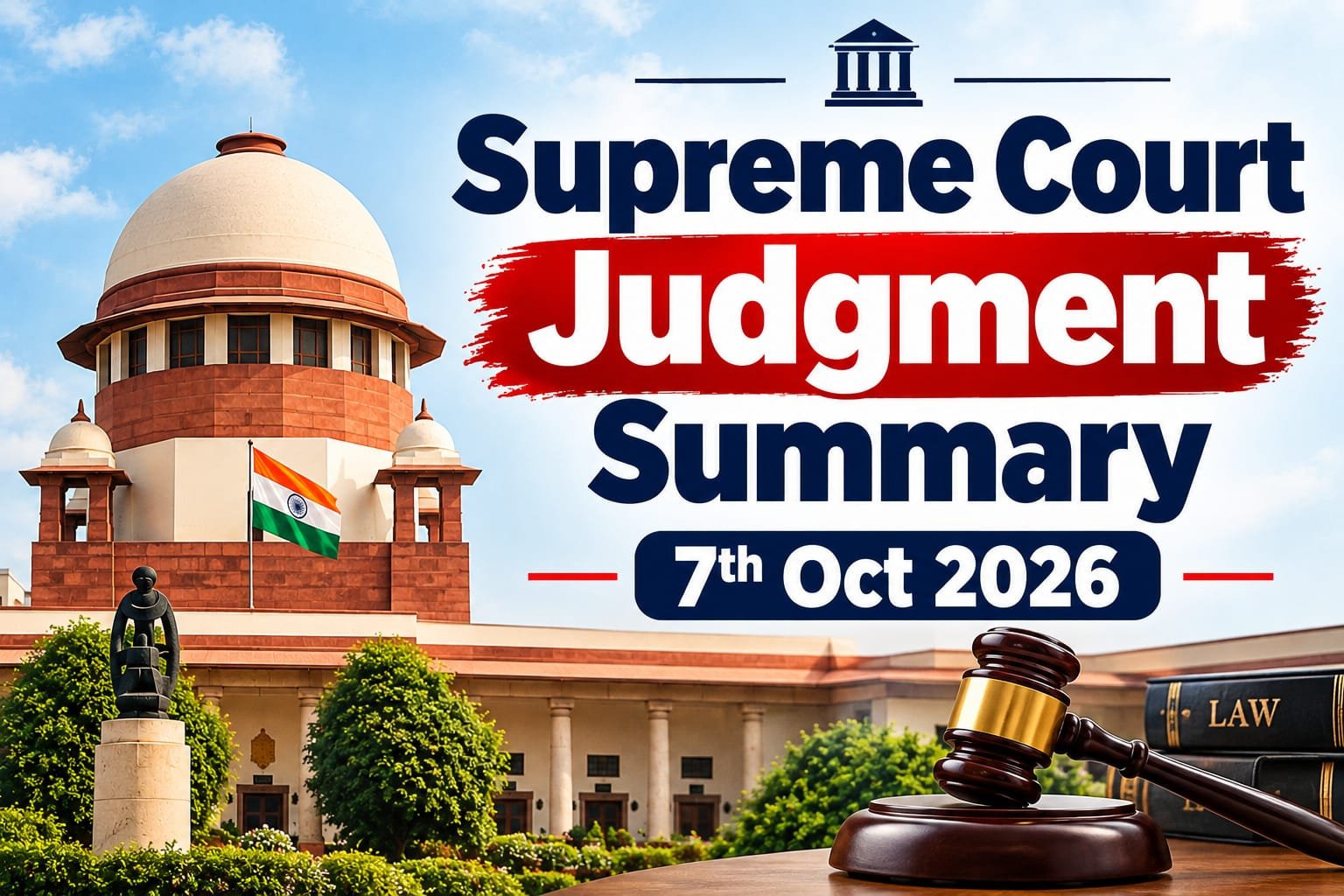
7th Oct, 2026
Classification of Electricity Subsidy: Revenue vs. Capital Receipt Under the Income Tax Act
The Supreme Court of India dismissed the civil appeal filed by M/s. Mepco Industries Ltd., affirming the findings of the lower tax authorities and the Madras High Court. The core legal issue was whether an electricity subsidy of ₹16,20,745 received by the appellant under a Government of Pondicherry scheme for Assessment Year 1997–98 constituted a tax-exempt capital receipt or a taxable revenue receipt. Applying the established “purpose test,” the Court held that because the subsidy was operational in nature—calculated based on power consumption after the commencement of production to lower electricity costs rather than for setting up capital assets—it must be treated as a revenue receipt liable to income tax.
2026 INSC 1090: M/s. Mepco Industries Ltd. v. Commissioner of Income Tax, Madurai (D.O.J. 07.10.2026)
Modification of Conviction: Differentiating Robbery from Grievous Hurt in the Absence of Stolen Asset Recovery
The Supreme Court of India partly allowed a criminal appeal preferred against the Bombay High Court’s judgment that had affirmed the appellant’s conviction under Section 394 of the Indian Penal Code (IPC) and a sentence of seven years rigorous imprisonment. The case pertained to a night-time farm assault in 1993, where the appellant was alleged to have assaulted the complainant and stolen her gold ornaments. While the Court held that the eyewitness identification of the appellant was reliable despite the lack of a Test Identification Parade, it observed that the charge of robbery under Section 394 IPC could not stand due to the non-recovery of stolen items or proof of stolen property. Applying the principle of cognate offences under Section 222 CrPC, the Apex Court altered the conviction to Section 325 IPC (causing grievous hurt) and reduced the sentence to the period of imprisonment already undergone (approximately 10 months).
2026 INSC 1091: The State of Maharashtra v. Appa (D.O.J. 07.10.2026)
Election Petitions: Strict Compliance Under Section 81 of the Representation of the People Act
The Supreme Court of India dismissed a Special Leave Petition challenging the Madras High Court’s dismissal of an election petition in limine. The petitioner had challenged the election of Respondent No. 1 to the Tamil Nadu Legislative Assembly from the Thirumayam Constituency. The primary legal question was whether the requirement of personal presentation of an election petition by the petitioner under Section 81 of the Representation of the People Act, 1951 (RP Act) and Rule 7 of the Madras High Court Election Petitions Rules, 1967 is mandatory, and whether non-compliance entails automatic dismissal at the threshold under Section 86(1) of the RP Act. The Apex Court affirmed that presentation “by” the petitioner himself is an essential statutory prerequisite and that failure to personally present the petition renders it non-maintainable, necessitating threshold dismissal under Section 86(1).
2026 INSC 1092: V. Pon. Paneerselvam v. S. Regupathy and Others (D.O.J. 07.10.2026)
Injury Location Does Not Negate Attempt to Murder
The Supreme Court of India allowed a criminal appeal filed against an order of the Rajasthan High Court, which had quashed the charge under Section 307 of the Indian Penal Code (IPC) against respondent No. 2 and directed the trial court to frame a charge under Section 308 IPC instead. Reversing the High Court’s ruling, the Apex Court held that to attract Section 307 IPC (attempt to murder), it is not essential that a fatal or life-threatening injury be inflicted, nor does the mere location of wounds on non-vital body parts exclude its applicability. Intention or knowledge must be deduced from the totality of circumstances—including the weapons used, persistent vehicular assault, prior animosity, and the manner of execution. Finding that a strong prima facie case existed and that courts should avoid mini-trials at the charge stage, the Supreme Court restored the trial court’s order framing charges under Section 307 IPC.
2026 INSC 1093: Abhishek v. State of Rajasthan & Ors. (D.O.J. 07.10.2026)
Statutory Qualification Rules Prevail: Reinstatement of Teacher Lacking NCTE-Recognized Certificate Quashed
The Supreme Court of India allowed a civil appeal filed by the State of Bihar and set aside the judgment of a Division Bench of the Patna High Court, which had ordered the reinstatement of a Trained Block Teacher with full back wages and monetary benefits. The Apex Court held that candidate eligibility for public employment must be judged as of the date of recruitment or application under the governing statutory rules. Because the respondent was appointed in 2007 under the Bihar Panchayat Elementary Teacher (Employment and Service Conditions) Rules, 2006, which strictly mandated a teacher training qualification from an institution recognized by the National Council for Teacher Education (NCTE), his 1995 pre-NCTE certificate from an unrecognized private college rendered him ineligible for the post at the time of appointment.
2026 INSC 1094: The State of Bihar and Ors. v. Nandeshwar Kumar (D.O.J. 07.10.2026)
Balance of Equity in Land Acquisition:SC Directs ₹15 Crore Additional Deposit While Continuing Interim Stay
The Supreme Court of India disposed of cross-appeals filed by M/s JK Paper Ltd. and private landowners against a common interim order of the Gujarat High Court in pending land acquisition First Appeals. While declining to interfere under Article 136 with disputed questions of fact regarding possession timelines and compensation calculations, the Apex Court directed the company to deposit an additional ₹15 crore with the High Court within two months to keep the stay on the enhanced award and execution proceedings operational. The Court rejected the company’s attempt to lower land value based on an existing gorge/waterlogging encumbrance, holding that such facts were known at the initiation of acquisition, and requested the High Court to expedite the final disposal of the pending appeals.