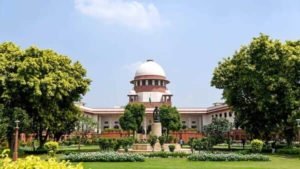
In the case of Unchgaon Village Panchayat v. Kolhapur Municipal Corporation and Another (2026), the Supreme Court of India dismissed appeals by a village panchayat, ruling that a Civil Court lacks the jurisdiction to adjudicate disputes regarding the determination or extension of municipal limits.
Case Background
The dispute involved the Unchgaon Village Panchayat and the Kolhapur Municipal Corporation concerning jurisdiction over specific lands in Village Unchgaon. In 2013, the Corporation issued a public notice declaring that several survey numbers fell within its municipal limits and that unauthorized constructions on these lands were liable for demolition.
The Panchayat filed a civil suit seeking a declaration that these lands were never validly included in the Corporation’s limits and requested a permanent injunction against any demolitions. The Corporation contended that the lands had been included in its limits via historical notifications from 1942, 1945, and 1946.
Key Legal Issues
The central question was whether a Civil Court has the jurisdiction to entertain a suit challenging the validity of municipal limits established under Section 3 of the Maharashtra Municipal Corporations Act (MMC Act).
Findings of the Court
The Supreme Court upheld the Bombay High Court’s decision to dismiss the suit based on the following principles:
- Legislative Nature of Power: The Court held that the power to specify or alter municipal limits under Section 3 of the MMC Act is a statutory and legislative function of the State Government. Consequently, the validity or legality of such an exercise of power cannot ordinarily be the subject of a civil suit seeking a declaration and injunction.
- Domain of Public Law: The reliefs sought by the Panchayat were not confined to private civil rights but were aimed at invalidating the State’s statutory authority regarding municipal limits and planning control. The Court determined that such matters fall within the domain of public law and are not suitable for adjudication in a collateral civil proceeding.
- Bar under MRTP Act: The Court noted that since the Corporation acted as a planning authority under the Maharashtra Regional and Town Planning Act (MRTP Act), Section 149 of that Act expressly bars Civil Courts from questioning orders or notices issued by authorities empowered under the Act.
- Effect of Historical Notifications: Evidence showed that the inclusion of the lands was traceable to notifications dating back to 1945. The Court ruled that a challenge raised decades later could not be permitted to unsettle a position that has attained “long attained certainty”.
Conclusion
The Supreme Court concluded that the High Court correctly determined that the Civil Court lacked jurisdiction. Finding no merit in the appeals, the Court dismissed them, vacated the previous interim “status quo” order, and disposed of a related contempt petition.
2026 INSC 405
Unchgaon Village Panchayat V. Kolhapur Municipal Corporation And Another(D.O.J. 22.04.2026)