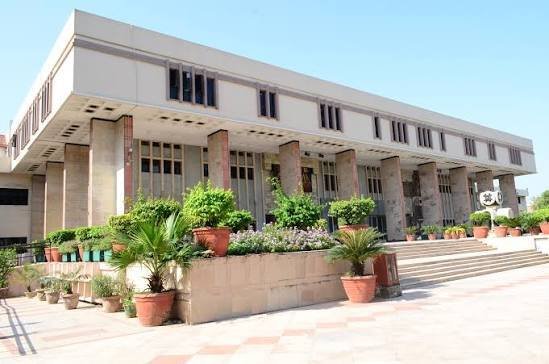
In this commercial appeal filed under Section 37 of the Arbitration and Conciliation Act, 1996, the appellant (TMB Electronics) challenged a judgment dated December 15, 2023, passed by a learned Single Judge who had dismissed the appellant’s petition under Section 34 of the Act against an arbitral award dated August 29, 2023. The dispute arose from a construction agreement dated March 13, 2018, executed between the appellant and respondent No. 1 (Shanti Developers) for building a factory in Sonipat, Haryana, under the architectural supervision of respondent No. 2. The Sole Arbitrator had partially allowed respondent No. 1’s claim, awarding a sum of ₹6,14,97,594/- towards work done under the original agreement, along with interest and costs, while rejecting other heads. A division bench comprising Justice V. Kameswar Rao and Justice Manmeet Pritam Singh Arora dismissed the appeal, holding that the findings of the Arbitrator—grounded in contemporaneous evidence like WhatsApp chats, progress photographs, and the pleadings—were factual, well-reasoned, and beyond the limited scope of interference under Sections 34 and 37 of the Act.
Background and Claims Before the Arbitrator
- The Project & Dispute: The parties entered into an agreement on March 13, 2018, requiring completion within 12 months (by March 2019). Respondent No. 1 claimed that work was completed by August/September 2020 and raised a final bill of ₹13,37,98,982/-, out of which ₹5,16,00,000/- was paid, leaving a balance of ₹8,21,98,982/-.
- Arbitrator’s Award: The Sole Arbitrator split the final bill into various components and awarded ₹6,14,97,594/- for work done under the original agreement (inclusive of GST after adjusting actual payments made by the appellant), while rejecting claims for loss of profits, extra work, and price escalations.
Key Contentions of the Appellant
- Non-Completion & Abandonment: The appellant contended that the work was never completed and was abandoned by respondent No. 1 in November 2019, necessitating completion by a third party.
- Procedural Lapses: The appellant argued that respondent No. 1 failed to issue a formal notice of completion or obtain a completion certificate under Clause 23 of the agreement, and that measurement books were ignored.
- GST Controversy: It was argued that the awarded amount erroneously included GST components that respondent No. 1 had allegedly failed to deposit with the tax authorities.
High Court’s Analysis and Findings
- Evidence of Completion: The Division Bench concurred with the Single Judge and Arbitrator that records, including admitted WhatsApp group chats and progress photographs, explicitly showed active construction continuing well beyond November 2019 up to September 2020.
- Vague Defense: The appellant’s defense regarding abandonment was found to be vague, lacking specifics on dates, third-party agencies hired, or any counter-claims for damages.
- GST Compliance: The Court held that the non-deposit of GST by the contractor is a matter for statutory tax authorities to handle and cannot be used to nullify a legitimate contractual claim under the award. However, the Court clarified that the appellant is entitled to seek proof of GST deposit after paying the awarded amount with up-to-date interest.
- Scope of Appellate Review: Reaffirming the principles governing Section 37 proceedings, the Court emphasized that factual findings based on proper appreciation of evidence cannot be re-examined or overturned unless found to be perverse or lacking any evidentiary basis.
Final Outcome
- Appeal Dismissed: The appeal was found to be completely devoid of merit and was accordingly dismissed.