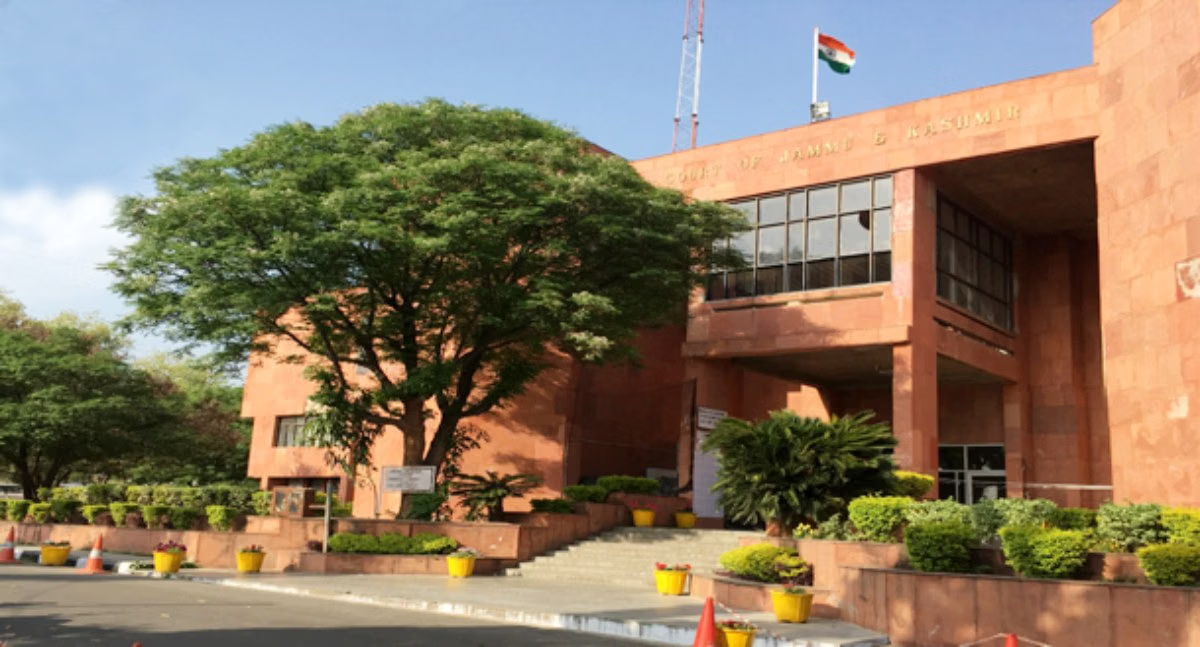
The High Court of Jammu & Kashmir and Ladakh at Srinagar dismissed a service writ petition filed by Mohammad Yaseen Khan, who challenged the note appended to Rule 1 of SRO 28 dated January 25, 1996, which governs the restructuring of the driver cadre and conditions promotion to “Chauffeur” upon the availability of vacancies. The petitioner, who retired as a Driver on March 31, 2025, argued that completing five years of service should automatically entitle an employee to functional promotion and sought to strike down the rule as unconstitutional. Justice Shahzad Azeem held that promotion is not a fundamental or absolute right, that creating or expanding cadre posts is an executive prerogative of the government, and that courts cannot issue a mandamus to compel creation of posts or structure changes. The Court further noted that since the petitioner had already received three financial upgradations through in-situ promotions and failed to demonstrate any actual financial loss, the petition lacked merit and was dismissed.
- Factual & Service Background:
- The petitioner was appointed as a Driver on March 25, 1989. Over the course of his service, he successfully received three in-situ promotions (Higher Standard Pay Scale) under SRO 14 of 1996, upgrading his financial status across various pay scales up to the post-retirement period.
- Under SRO 28 of 1996, the driver cadre was restructured, specifying that promotions from Grade-II to Grade-I and subsequently to ‘Chauffeurs’ are subject to the availability of posts after completing minimum qualifying service. Due to a small cadre size and an existing senior occupying the single available Chauffeur post, the petitioner could not secure a functional promotion.
- Core Legal Arguments of the Petitioner:
- The petitioner contended that the rule making promotion conditional upon the availability of posts is arbitrary, unreasonable, and ultra-vires to the Constitution.
- He argued that completing five years of service in a particular pay scale should automatically entitle him to functional promotion to the next higher grade, seeking to strike down the note to Rule 1 of SRO 28.
- Stand of the State and Respondents:
- The respondents defended the rule, highlighting that the petitioner had already enjoyed substantial monetary and financial benefits through three in-situ promotions.
- It was submitted that non-promotion to the functional post of Chauffeur was strictly due to the non-availability of a vacancy within the limited cadre strength, and functional promotion cannot be claimed as an absolute right.
- Judicial Reasoning and Precedents:
- The Court reiterated that an employee has only the right to be considered for promotion under Articles 14 and 16, which does not translate into a right to actual appointment or a right to force cadre expansion.
- Relying on the Supreme Court ruling in State of Odisha v. Sreepati Ranjan Dash (2026 SCC Online SC 879), the Court affirmed that employees have no vested right or legitimate expectation to compel the government to fill vacancies through promotion during cadre restructuring.
- Citing Union of India v. Ilmo Devi ((2021) 20 SCC 290), the High Court underscored that courts under Article 226 cannot issue a mandamus directing the government to sanction, create posts, or rewrite valid administrative service rules merely because of stagnation in small cadres.
- Final Ruling:
Because the petitioner failed to prove any discrimination violating Articles 14 and 16, and could not demonstrate any financial loss despite receiving three financial upgradations prior to superannuation on March 31, 2025, the writ petition was dismissed along with pending miscellaneous applications.
J.O. (Web) 2026 J & K 6
Mohammad Yaseen Khan v. State of Jammu & Kashmir (now UT) and Ors. (D.O.J. 06.07.2026)
J.O. (Web) 2026 J & K 6 click here to view full text of judgment