Indian Judgements

Indian Judgements

Legality of Loan Diversion and One-Time Settlement: High Court Refuses to Quash Charge Sheets Against Promoters

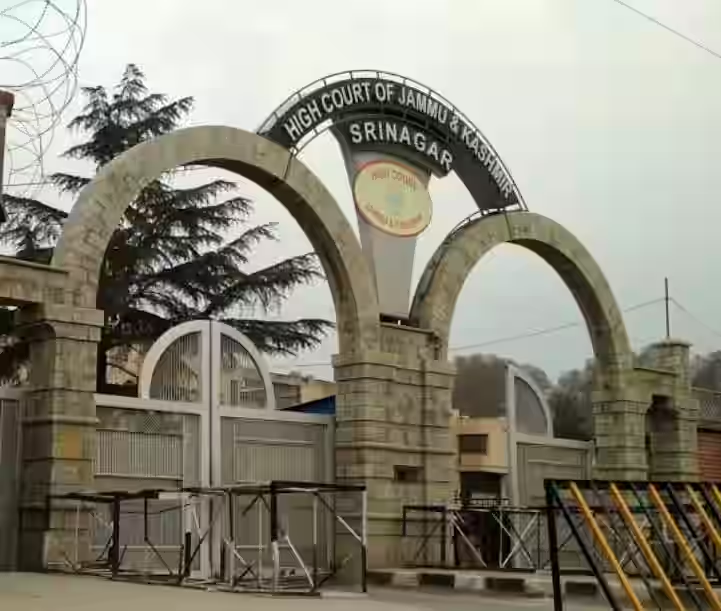
The High Court of Jammu & Kashmir and Ladakh at Srinagar dismissed a batch of eight petitions filed under Section 482 of the Cr.P.C. seeking to quash multiple charge sheets and supplementary charge sheets arising out of FIR No. 15/2019 and CBI case RCBD12021E0004. The case involves allegations that the management of M/S Aman Hospitality Pvt. Ltd. (AHPL), in criminal conspiracy with officials of J&K Bank, siphoned off and diverted multi-crore rupee loans granted for constructing a five-star hotel project in Delhi into shell and sister companies. The petitioners contended that the transactions were mere reimbursements of turnkey expenses, that forensic audits found no fraud, and that the loan account’s distress was due to external infrastructure delays. However, the Single Bench held that prima facie evidence established fund diversion, unauthorized utilization, and fraudulent inducement causing substantial pecuniary loss to the bank through a heavily discounted One-Time Settlement (OTS), thereby refusing to invoke inherent powers to quash the proceedings.

  • Factual Background & Loan Disbursements:
    • M/S Aman Hospitality Pvt. Ltd. (AHPL) obtained major term loans (Term Loan-I of Rs. 100 crores, Term Loan-II of Rs. 50 crores, Term Loan-III of Rs. 77 crores, and a Funded Interest Term Loan of Rs. 47.21 crores) from J&K Bank (Ansal Plaza Branch, New Delhi) as part of a consortium for a Twin Five Star Hotel project.
    • Investigations by the Anti-Corruption Bureau (ACB) and later the Central Bureau of Investigation (CBI) revealed that tranches released into AHPL’s designated account were immediately transferred to turnkey contractors (like M/S APL) and subsequently routed to various dummy/shell firms and entities owned, managed, or controlled by petitioner Raj Singh Gehlot (such as M/S Raj Commercial and Agencies, NGR Consultants, M & N Commercials, etc.).
  • Misutilization and Diversion of Funds:
    • Loan amounts were diverted to pay self-assessment taxes, service loan accounts of other lending banks, buy Fixed Deposits (FDs), and handle miscellaneous expenses contrary to the specific project-implementation conditions of the loan sanctions.
    • The defense argument that these transfers constituted “reimbursement” for prior expenses incurred by the turnkey contractor was rejected because the loan sanction terms explicitly mandated that funds be utilized solely for construction through the designated account.
  • One-Time Settlement (OTS) and Bank Loss:
    • Due to fund misutilization, the loan account turned into a Non-Performing Asset (NPA).
    • The borrower company subsequently proposed an OTS, and J&K Bank agreed to settle the outstanding dues (totaling Rs. 289.28 crores) for a meager amount of Rs. 128.94 crores—which was less than even the principal amount advanced—inflicting a massive pecuniary loss on the bank.
  • Legal Reasoning on Quashing (Section 482 Cr.P.C.):
    • Invoking the principles laid down in State of Haryana v. Bhajan Lal and Rajiv Thapar v. Madan Lal Kapoor, the Court reiterated that High Courts should not conduct a meticulous evaluation of defense evidence or test witness credibility at the pre-trial stage unless the defense material is of impeccable, unrefutable “sterling quality”.
    • The reports of forensic auditors could not override the charge sheet findings, as the auditors had merely relied on selective explanations provided by the accused company.

The completion of the hotel project and the existence of an OTS proposal do not wipe out antecedent criminal liability or fraud if the initial procurement and deployment of the loan involved dishonest inducement and active siphoning.

J.O. (Web) 2026 J & K 1: 2026 : JKLHC-SGR:209

Madhu Bakshi v. Jammu and Kashmir Anti-Corruption Bureau & Anr. (D.O.J. 30.06.2026)

J.O. (Web) 2026 J & K 1 click here to view full text of judgment

Next Story

Succession: Validating Testamentary Dispositions and Spousal Status Against Collateral Challenges

This regular second appeal arose from concurrent judgments and decrees passed by the lower appellate court and the trial court, which dismissed the plaintiffs’ suit for possession of agricultural land measuring 23 bighas 19 biswas situated in Village Sankhera, Tehsil Jagadhri. The plaintiffs, claiming to be collaterals (nephews) of the deceased owner Bishan Singh, challenged a registered will dated 15.03.1976, a civil court consent decree, and subsequent alienations made in favor of defendant No. 1 (Smt. Debo) and subsequent purchasers, arguing that the land was ancestral and that Bishan Singh, being a Jat governed by customary law, could not alienate it or execute a will, and further disputing Debo’s marital status. The Punjab and Haryana High Court held that the will was duly proved under Section 63 of the Indian Succession Act and Section 68 of the Evidence Act through an attesting witness, that long cohabitation and an unchallenged 1978 civil court decree established Debo’s status and rights, and that customary limitations did not invalidate a disposition made in favor of a caretaker for services rendered. The High Court accordingly dismissed the second appeal, affirming the concurrent findings of the lower courts.

  • Factual Background:
    • Bishan Singh alias Bishna, an issueless owner of the suit land, died on 24.08.1979.
    • During his lifetime, he executed a registered will dated 15.03.1976 ( D-1) in favor of defendant No. 1 (Smt. Debo) and suffered a consent decree on 22.03.1978 (Ex. D-8 and Ex. D-9) transferring half of the property to her.
    • Debo subsequently transferred a portion of the land to defendant Nos. 4 and 5 (Zora Singh and Nasib Singh).
    • The plaintiffs (collaterals through their deceased father Beli Ram) filed a suit challenging the will, the consent decree, and the sale deeds, claiming the property was ancestral and that Smt. Debo was not the legally wedded wife of Bishan Singh.
    • Both the trial court (judgment dated 07.12.1987) and the first appellate court (judgment dated 17.07.1991) dismissed the plaintiffs’ suit.
  • Contentions of the Appellants (Plaintiffs):
    • Bishan Singh, being a Jat governed by customary law, had no capacity to bequeath or transfer ancestral property in the presence of collaterals.
    • Debo could not have performed a valid Karewa marriage with Bishan Singh as she belonged to a different community and had prior marriages without legal divorce.
    • The will dated 15.03.1976 was surrounded by suspicious circumstances, including the attesting witness residing in a neighboring village and the active presence of the beneficiary during execution.
  • Contentions of the Respondents (Defendants / Purchasers):
    • The validity of the will and the marital status of Smt. Debo had already been affirmed in earlier litigation (Civil Suit No. 368 of 1979) where the plaintiffs’ father represented minor parties and acknowledged facts.
    • The 1978 decree transferring half the property to Deb as wife was never independently challenged or set aside and had attained finality.
    • Long cohabitation and personal service rendered to the issueless proprietor constitute valid consideration for a disposition under both general law and custom.
  • Observations and Analysis by the High Court:
    • Proof of Will: Referring to Supreme Court precedents including Murthy v. C. Saradambal and Kalyanaswamy v. L. Bakthavatsalam, the Court found that the will was duly proved under Section 63 of the Indian Succession Act and Section 68 of the Evidence Act through the testimony of attesting witness Lal Chand (DW-2) and corroborating notarial endorsements. Minor factors like the witness belonging to a neighboring village did not constitute real or substantial suspicious circumstances.
    • Spousal Status and Cohabitation: Citing Kattukandi Edathil Krishnan v. Kattukandi Edathil Valsan, the Court noted that long cohabitation raises a strong presumption of a valid marriage. Furthermore, the 1978 decree recording Debo as Bishan Singh’s wife had attained finality and could not be assailed collaterally.
    • Customary Law and Services Rendered: Relying on Nathu Ram v. Jug Lal and Mohinder Singh v. Mal Singh, the Court observed that even under customary law, exceptions exist allowing a sonless proprietor to provide for a person who resided with and rendered personal services to him. The plaintiffs’ inconsistent conduct—having previously acknowledged Debo’s title through inheritance in other judicial proceedings—disentitled them from approbating and reprobating.
  • Final Conclusion: The High Court dismissed the regular second appeal, confirming the concurrent judgments and decrees of the lower courts upholding the dismissal of the plaintiffs’ suit.

J.O. (Web) 2026 P&H 12

Surmukh Singh and others v. Smt. Debo and others (D.O.J. 06.07.2026)

J.O. (Web) 2026 P&H 12 click here to view full text of judgment

Next Story

Permitting Handwriting Experts to Examine Certified and Photocopied Documents in Defense

This revision petition was filed under Article 227 of the Constitution of India challenging an order dated 22.12.2021 passed by the Additional Civil Judge (Senior Division), Amritsar, which had rejected an application under Section 151 CPC filed by defendant No. 1 seeking permission to examine a handwriting expert in defense evidence. The underlying suit involved claims for permanent and mandatory injunction alongside alternative possession regarding properties in Green Avenue, Amritsar, where the defendant relied heavily on a family compromise and various sale deeds whose signatures were disputed by the plaintiff’s legal heir during cross-examination. The Punjab and Haryana High Court held that the trial court erred in shutting out expert evidence merely because the documents in question were certified copies or photocopies, emphasizing that the viability and reliability of comparison are matters for the expert to assess and subject to judicial evaluation during trial. Consequently, the High Court allowed the revision petition and set aside the trial court’s order.

  • Factual Background:
    • The plaintiff, Satish Kumar Arora, filed a civil suit seeking to restrain defendant No. 1 (Pran Nath Arora) from raising unauthorized construction on properties at Green Avenue, Amritsar, and sought demolition or alternative possession.
    • The plaintiff claimed ownership through historical sale deeds, a gift deed, and an oral partition, while defendant No. 1 contested the suit by asserting a family compromise dated 05.07.2004 and producing various sale deeds ( D-2 to Ex. D-13).
    • During the trial, after the plaintiff’s death, his legal heir Nitin Arora denied the signatures of his late father on these documents and the compromise deed during cross-examination, prompting defendant No. 1 to file an application on 03.12.2021 to examine a handwriting expert.
  • Contentions of the Petitioner (Defendant No. 1):
    • The documents and the compromise deed formed the core of the defense, and the plaintiff’s legal heir had deliberately denied the genuine signatures of the deceased plaintiff.
    • Standard signatures of the plaintiff were readily available on the judicial record (such as the plaint and written statements from previous litigation), and certified copies of public documents could legitimately be subjected to expert scrutiny.
  • Contentions of the Respondents (Plaintiffs):
    • The application was a belated tactic aimed at delaying proceedings in a suit pending since 2012.
    • Expert comparison of signatures from photocopies or certified copies, rather than primary originals, is legally impermissible, and the original compromise deed was already placed on a separate judicial file.
  • Observations and Analysis by the High Court:
    • Admissibility of Expert Evidence on Copies: Citing coordinate bench precedents in Dharam Singh v. Labh Singh and Harbans Singh v. Jagir Singh, the Court reiterated that best available evidence should not be shut out on a preposterous plea that comparison cannot be carried out using good-quality photocopies or certified copies of public documents.
    • Role of the Expert versus the Court: It is for the expert to opine whether a proper comparison can be conducted, and their testimony remains subject to rigorous cross-examination and final judicial evaluation. The trial court acted prematurely by barring the defense from presenting its expert witness at the threshold.
    • Rejection of Objections: The court distinguished contrary rulings cited by the respondents, noting they were inapplicable at the stage where the expert had not even been examined yet.
  • Final Conclusion: The High Court allowed the revision petition, set aside the trial court’s order dated 22.12.2021, and permitted the petitioner to examine a handwriting expert in defense to compare the deceased plaintiff’s signatures in accordance with law.

J.O. (Web) 2026 P&H 11

Pran Nath Arora v. Satish Kumar Arora (since deceased) through LRs and others (D.O.J. 01.07.2026)

J.O. (Web) 2026 P&H 11 click here to view full text of judgment
Next Story

Permissive Pleadings: Allowing Plaint Amendments to Address Defenses Raised in Written Statements

This revision petition was filed under Article 227 of the Constitution of India challenging an order dated 04.10.2019 passed by the Civil Judge (Junior Division), Chandigarh, which had dismissed the petitioner-plaintiff’s application under Order 6 Rule 17 of the CPC seeking amendment of the plaint. The original suit was filed for permanent prohibitory injunction based on a 1994 registered sale deed, but the defendant raised a written statement introducing subsequent decrees and a gift deed concerning the property. The Punjab and Haryana High Court held that the trial court committed a manifest error by treating the application as belated, noting it was filed merely weeks after the written statement, and that amendments necessitated by disclosures in a written statement to determine the real controversy and avoid multiplicity of litigation ought to be liberally permitted. The High Court allowed the revision petition, set aside the trial court’s order, and granted the amendment application.

  • Factual Background:
    • The petitioner-plaintiff, Meenu Malhotra, instituted a civil suit for permanent prohibitory injunction to protect her peaceful possession over a plot in Village Burail, Chandigarh, purchased via a registered sale deed on 21.04.1994.
    • The respondent-defendant contested the suit through a written statement filed on 16.05.2016, asserting that a previous 1995 declaration decree affected the vendor’s title and that a 3/4th share of the property was transferred to him via a gift deed on 24.09.2015.
    • To counter these new assertions, the petitioner promptly moved an application for amendment of the plaint on 30.05.2016, which the trial court dismissed on 04.10.2019.
  • Contentions of the Petitioner:
    • The trial court completely miscalculated the timeline, failing to recognize that the amendment application was filed at the earliest possible opportunity (within two weeks of the written statement), while the delay in disposal was attributable to the defendant’s tardiness in filing a reply.
    • The amendments were essential for the proper adjudication of the core controversy and to prevent a multiplicity of legal proceedings, a principle supported by precedents such as Prem Lata v. Baljeet.
  • Contentions of the Respondent:
    • The impugned order of the trial court suffered from no illegality.
    • A separate suit had already been filed challenging the sale deed in favor of the petitioner, and the petitioner could agitate her claims there.
  • Observations and Analysis by the High Court:
    • Principles Governing Amendments: Relying extensively on the landmark Supreme Court ruling in Life Insurance Corporation of India v. Sanjeev Builders Private Limited, the Court reiterated that amendments necessary for determining the real question in controversy must be liberally allowed—especially pre-trial—unless they cause grave injustice, introduce time-barred claims without basis, or fundamentally alter the core nature maliciously.
    • Correction of Trial Court’s Error: The trial court erred in branding the application as delayed since it was filed immediately after the written statement was placed on record in May 2016.
    • Addressing Written Statement Disclosures: When a defendant introduces new facts or documents (such as subsequent gift deeds or decrees) in a written statement, the plaintiff must be permitted to amend the pleadings to respond to those specific assertions rather than being forced into a separate, multi-layered litigation loop. Issues of limitation, if any, can be framed separately and evaluated during trial.
  • Final Conclusion: The High Court allowed the revision petition, set aside the trial court’s order dated 04.10.2019, and permitted the amendment of the plaint, requesting the trial court to expedite the long-pending matter.

J.O. (Web) 2026 P&H 10

Meenu Malhotra v. Jasbir Singh (D.O.J. 01.07.2026)

J.O. (Web) 2026 P&H 10 click here toview full text of judgment

Next Story

Personal Liberty & Speedy Trial: Granting Regular Bail Based on Clean Antecedents and Completed Investigation

This criminal miscellaneous petition was filed under Section 483 of the Bharatiya Nagarik Suraksha Sanhita, 2023 (BNSS) seeking regular bail in connection with FIR No. 415 dated 16.08.2025 registered at Police Station Rania, District Sirsa, for offenses including rioting, unlawful assembly, and assault under the Bharatiya Nyaya Sanhita (BNS) / IPC equivalents. The petitioner, Kuldeep Kumar, was accused of being part of an unlawful assembly that wrongfully restrained and assaulted the complainant and his friend with weapons. The Punjab and Haryana High Court noted that the petitioner had already suffered incarceration for over five and a half months, possessed a clean criminal record, and that the investigation was complete with the injured person already discharged from the hospital. Invoking landmark Supreme Court jurisprudence on the presumption of innocence, bail as the general rule, and the right to a speedy trial under Article 21 of the Constitution, the High Court allowed the petition and granted regular bail to the petitioner subject to standard conditions.

  • Factual Background:
    • An FIR was lodged by the complainant, Naresh, stating that on 12.08.2025, while returning home, he and his friend Mandeep were wrongfully restrained near a village intersection by the petitioner Kuldeep Kumar and several co-assailants arriving in a car.
    • The complainant alleged that the assailants attacked them with sharp-edged weapons (kappas) and wooden sticks (dandas), causing injuries.
    • The petitioner filed his first bail petition before the High Court after undergoing detention as an undertrial.
  • Contentions of the Petitioner:
    • The petitioner has already undergone prolonged incarceration (5 months and 20 days) and possesses clean antecedents with no criminal history.
    • The FIR itself is vague, naming multiple individuals without attributing a specific overt role or specific weapon usage to the petitioner, and none of the injuries sustained were declared dangerous to life.
  • Contentions of the State:
    • The State counsel opposed the bail plea, emphasizing that the petitioner is specifically named in the FIR as part of an unlawful assembly armed with deadly weapons that inflicted serious injuries on the complainant.
    • Investigation established that the petitioner was armed with a sharp-edged weapon during the commission of the crime.
  • Observations and Analysis by the High Court:
    • Relevant Factors for Bail: The Court highlighted that the petitioner has clean antecedents, has been in custody for nearly 5 months and 20 days, and that the investigation is fully complete with no further recoveries pending. Furthermore, the injured victim has been discharged from the hospital.
    • Jurisprudence on Bail and Liberty: Citing Supreme Court rulings in Dataram v. State of Uttar Pradesh, Satender Kumar Antil v. CBI, Tapas Kumar Palit v. State of Chhattisgarh, and Balwinder Singh v. State of Punjab, the Court reiterated that bail is the rule and jail is the exception. Depriving liberty before conviction is not punitive, and prolonged undertrial incarceration infringes upon the right to a speedy trial enshrined under Article 21 of the Constitution.
    • Lack of Prejudicial Risk: There was no material indicating that the petitioner would abscond, tamper with evidence, or fail to cooperate with the ongoing trial.

Final Conclusion: The High Court allowed the petition, directing that the petitioner be released on regular bail upon furnishing personal and surety bonds to the satisfaction of the trial court, subject to conditions preventing witness intimidation, requiring address disclosures, and prohibiting foreign travel without prior court permission.

J.O. (Web) 2026 P&H 9

Kuldeep Kumar v. State of Haryana (D.O.J. 06.07.2026)

J.O. (Web) 2026 P&H 9 click here to view full text of judgment
Hi Judgments Online