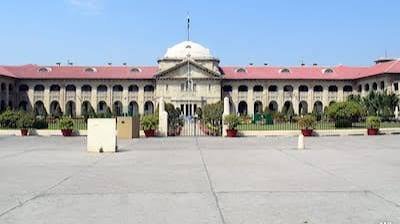
This application for leave to appeal was filed by the State of U.P. under Section 378(3) of the CrPC, challenging the judgment and order passed by the trial court which acquitted the accused respondents, Ramkesh and Ram Sagar, of charges under Sections 302, 201, 404, and 411 of the IPC. The prosecution case rested entirely on circumstantial evidence—specifically the “last seen together” theory and subsequent recoveries—after the deceased, Smt. Sangeeta, went missing on August 4, 2009, and her highly decomposed body was recovered from a waterlogged area near a canal on August 17, 2009. The Allahabad High Court meticulously examined the legal principles governing appeals against acquittal, reiterating that a trial court’s view strengthening the double presumption of innocence should not be disturbed unless it is perverse or impossible. Finding that the chain of circumstantial evidence was broken, the time gap between the last seen event and the recovery was substantial, and the identification of the highly decomposed body along with the alleged recoveries suffered from material contradictions, the High Court held that the trial court’s view was entirely plausible and accordingly rejected the application for leave to appeal.
- Factual Matrix and Trial Court Findings:
- On August 4, 2009, the deceased allegedly left her home with the accused Ramkesh on a motorcycle. When she did not return and her phone became unreachable, a search was launched, culminating in the recovery of an unknown decomposed female body on August 17, 2009.
- An FIR was initially lodged under Section 304 IPC, which later led to a chargesheet under Sections 302, 201, 404, and 411 IPC against Ramkesh and Ram Sagar.
- The trial court acquitted the accused persons, holding that the prosecution failed to establish a foolproof case, noting severe discrepancies regarding the identification of the body, missing-person reporting delays, questionable recoveries of ornaments/mobiles, and unconvincing last-seen evidence.
- Legal Principles on Appeals Against Acquittal:
- The High Court underscored the standard parameters for entertaining an appeal against acquittal under Section 378 CrPC, citing landmark precedents such as Bannareddy v. State of Karnataka, Jayamma v. State of Karnataka, Babu v. State of Kerala, and Jafarudheen v. State of Kerala.
- It was reiterated that an order of acquittal reinforces the presumption of innocence in favor of the accused, creating a double presumption that can only be pierced if the trial court’s evaluation suffers from absolute perversity, material misreading of evidence, or conclusions that are legally impossible.
- Evaluation of Circumstantial Evidence and the “Last Seen” Theory:
- Incomplete Chain of Circumstances: Because the case rested on circumstantial evidence, the court applied the classic “panchsheel” principles laid down in Sharad Birdhi Chand Sarda v. State of Maharashtra, requiring that every link in the chain must point unequivocally to the guilt of the accused.
- Time Gap and Last Seen Limitations: Citing judgments like Rambraksh v. State of Chhattisgarh and Anand Jakkappa Pujari v. State of Karnataka, the court noted that the last-seen theory is only safely applicable when the time gap between the parties being seen together and the death is so short that no third party could have intervened. Here, a vast gap of nearly two weeks existed between August 4 and August 17, 2009.
- Decomposed Body and Doubtful Identification: The autopsy surgeon (PW-9) noted that the body was heavily decomposed, infested with maggots, missing flesh, and partially eaten by animals, with liquefied brain membranes. Given that the body was found naked, eyewitness claims identifying the corpse purely through clothing or physical features presented irreconcilable contradictions with the statements of the informant and his son.
- Doubtful Recoveries: The alleged recoveries of the deceased’s mobile phone and necklace (mangalsutra) at the instance of the accused were heavily undermined by defense testimony and the glaring omission of any mention of missing jewelry in the initial FIR or inquest proceedings.
- Final Decision:
- The High Court concluded that the trial court adopted a reasonable and possible view upon a comprehensive appreciation of the evidence.
The application for grant of leave to appeal was rejected, and consequently, the government appeal stood dismissed.
J.O. (Web) 2026 ALL 19
State of U.P. v. Ramkesh and another (D.O.J. July 8, 2026)
J.O. (Web) 2026 ALL 8 click here to view full text of judgment